ACTED
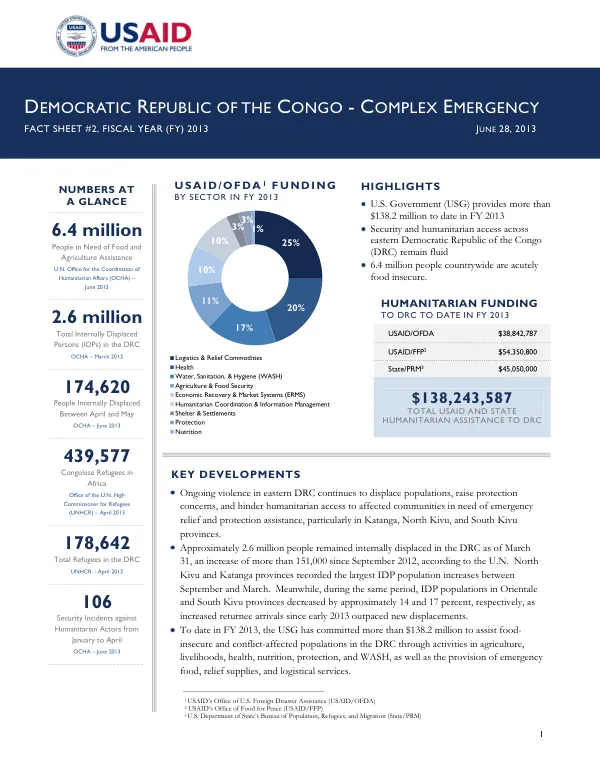
Humanitarian Funding to DRC to Date in FY 2013
The Democratic Republic of the Congo (DRC) is experiencing a complex emergency, with ongoing violence and displacement affecting millions of people.
2013 · 7 pages
Sign in to readA free account is required to download.
Abstract
As of March 31, 2013, approximately 2.6 million people were internally displaced, with North Kivu and Katanga provinces recording the largest IDP population increases. The U.N. Office for the Coordination of Humanitarian Affairs (OCHA) reported that 174,620 people were displaced between April and May, bringing the total IDP population to 2.6 million. The U.S. Government (USG) has committed more than $138.2 million to assist food-insecure and conflict-affected populations in the DRC through activities in agriculture, livelihoods, health, nutrition, protection, and Water, Sanitation, and Hygiene (WASH), as well as the provision of emergency food, relief supplies, and logistical services. The USG funding is allocated across various sectors, with the majority going towards Logistics & Relief Commodities, Health, and Water, Sanitation, and Hygiene (WASH). The humanitarian situation in the DRC remains fluid, with security and humanitarian access across eastern DRC remaining a concern. The USG has provided more than $138.2 million to date in FY 2013 to support humanitarian assistance in the DRC. The funding is being used to implement a range of interventions, including agriculture and food security, livelihoods, health, nutrition, protection, and WASH activities. North Kivu Province is one of the most affected areas, with approximately 934,000 IDPs as of May 25, accounting for more than one-third of the DRC's total IDP population. The province has experienced ongoing fighting between various Mai Mai militia groups and the M23 rebel group, resulting in protracted displacement and re-displacement. The USG is supporting 13 grantees in North Kivu with FY 2013 and ongoing FY 2012 funding to implement a range of interventions, including agriculture and food security, livelihoods, health, nutrition, protection, shelter and settlements, and WASH activities. South Kivu Province has also been affected by the conflict, with approximately 52,600 new IDPs registered in the first three months of 2013. The USG is supporting eight partners in South Kivu to provide emergency relief items and agriculture and food security, ERMS, health, protection, and WASH assistance to conflict-affected and food-insecure populations in the province.
Related documents