TEXAS A&M INTERNATIONAL UNIVERSITY
Humanitarian Intervention: A Debate on Sovereignty and Human Rights
Humanitarian intervention is a complex issue that has been debated by countries, agencies, and individuals for decades.
2016 · 2 pages
Sign in to readA free account is required to download.
Abstract
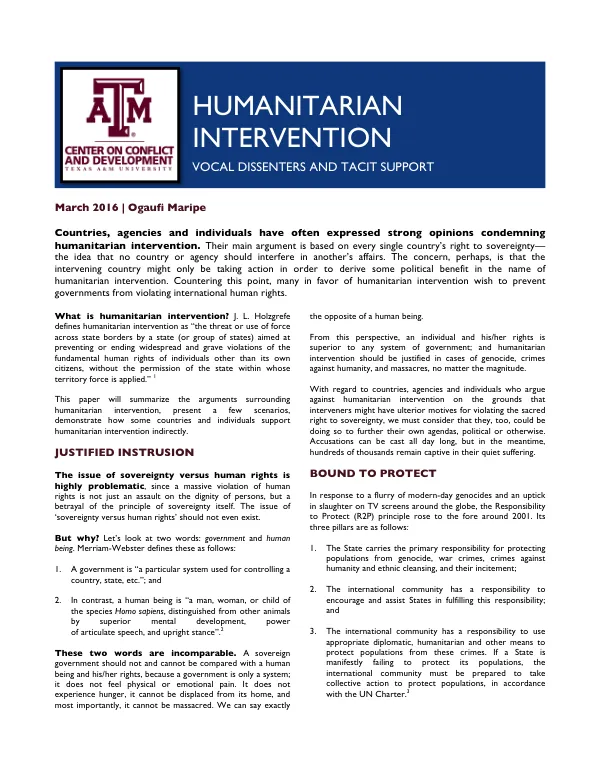
The concept of humanitarian intervention is defined as the threat or use of force across state borders by a state or group of states aimed at preventing or ending widespread and grave violations of fundamental human rights of individuals other than its own citizens, without the permission of the state within whose territory force is applied. The issue of sovereignty versus human rights is highly problematic, as a massive violation of human rights is not just an assault on the dignity of persons, but a betrayal of the principle of sovereignty itself. A government is a system used for controlling a country, state, or other entity, whereas a human being is a man, woman, or child of the species Homo sapiens, distinguished from other animals by superior mental development, power of articulate speech, and upright stance. These two words are incomparable, and an individual and their rights are superior to any system of government. Humanitarian intervention should be justified in cases of genocide, crimes against humanity, and massacres, no matter the magnitude. The Responsibility to Protect (R2P) principle, which was introduced around 2001, emphasizes the responsibility of states to protect their populations from genocide, war crimes, crimes against humanity, and ethnic cleansing, and the responsibility of the international community to encourage and assist states in fulfilling this responsibility. The R2P principle has three pillars: the state carries the primary responsibility for protecting populations, the international community has a responsibility to encourage and assist states in fulfilling this responsibility, and the international community has a responsibility to use appropriate diplomatic, humanitarian, and other means to protect populations from these crimes. If a state is manifestly failing to protect its populations, the international community must be prepared to take collective action to protect populations, in accordance with the UN Charter. Several scenarios demonstrate the direct and indirect support for humanitarian intervention. In 1971, India intervened in Pakistan on the basis of protecting human rights, although the justification was later deleted from the records of the UN Security Council. Tanzania and Vietnam performed separate interventions to stop the scourge of dictators in their respective regions, and the African Union supported Tanzania's decision to take action. The NATO member states that approved large-scale air strikes in Bosnia and Herzegovina following the Srebrenica massacre of 1995 also demonstrated tacit support for humanitarian intervention. Kofi Annan, the former Secretary-General of the UN, indirectly supported military intervention in his speeches following the Rwandan genocide and the Srebrenica massacre. He asserted that the UN Charter was never meant as a license for governments to trample on human rights and human dignity, and posed the question of how to respond to gross and systematic violations of human rights that offend every precept of our common humanity. The examples demonstrate that countries, agencies, and individuals generally support humanitarian intervention, although they are not always transparent about their positions. Silence is one of the most highly utilized mechanisms for supporting humanitarian intervention, and action must be taken against those who violate human rights. As a civilization, we will always struggle with the issue of humanitarian intervention, but action must be taken to protect individuals from extreme distress.