USAID DEC
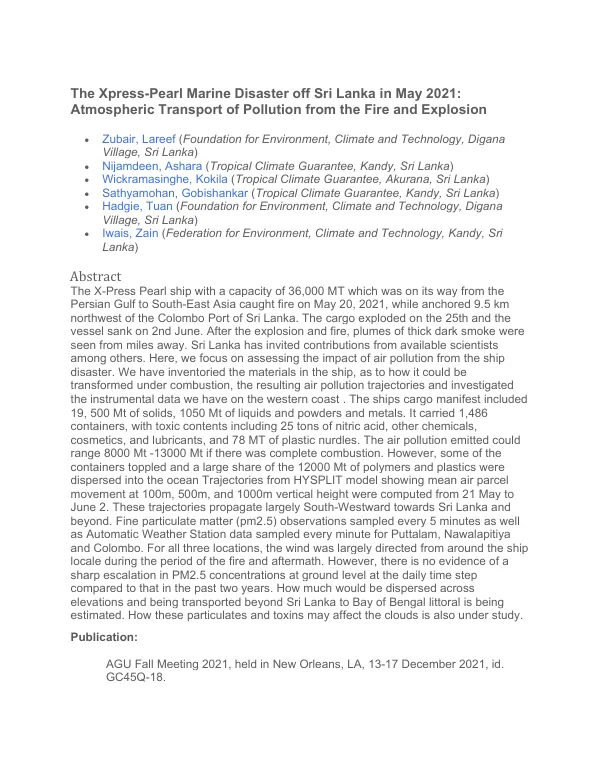
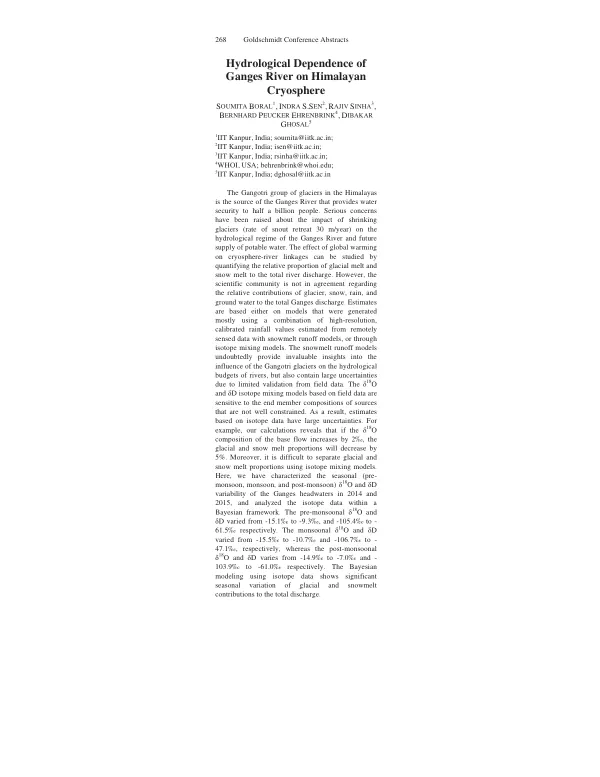
Hydrological Dependence of Ganges River on Himalayan Cryosphere
The Ganges River, a vital source of water for over half a billion people, originates from the Gangotri group of glaciers in the Himalayas.
2016 · 1 pages
Sign in to readA free account is required to download.
Abstract
Concerns have been raised about the impact of shrinking glaciers on the hydrological regime of the Ganges River and future water supply. The effect of global warming on cryosphere-river linkages can be studied by quantifying the relative proportion of glacial melt and snow melt to the total river discharge. Estimates of the relative contributions of glacier, snow, rain, and groundwater to the total Ganges discharge vary widely due to differences in methodology. Some studies rely on models that combine high-resolution rainfall data with snowmelt runoff models, while others use isotope mixing models based on field data. However, both approaches have limitations. Snowmelt runoff models contain large uncertainties due to limited validation from field data, while isotope mixing models are sensitive to the end member compositions of sources that are not well constrained. To address these limitations, researchers have characterized the seasonal variability of the Ganges headwaters in 2014 and 2015 using 18O and D isotope data. The pre-monsoonal 18O and D varied from -15.1‰ to -9.3‰ and -105.4‰ to -61.5‰, respectively. The monsoonal 18O and D varied from -15.5‰ to -10.7‰ and -106.7‰ to -47.1‰, respectively. The post-monsoonal 18O and D varied from -14.9‰ to -7.0‰ and -103.9‰ to -61.0‰, respectively. Bayesian modeling of the isotope data reveals significant seasonal variation in the contributions of glacial and snowmelt to the total discharge. The results suggest that the relative proportion of glacial melt and snow melt to the total river discharge varies depending on the season. This information can be used to improve estimates of the hydrological regime of the Ganges River and inform decision-making about water management and conservation. The findings of this study have implications for understanding the impact of global warming on cryosphere-river linkages and the future supply of potable water. The results highlight the need for continued research into the hydrological regime of the Ganges River and the development of more accurate models for estimating the relative contributions of different water sources to the total discharge.