USAID
Water Resources Profile Series: India Water Resources Profile Overview
India's water resources are characterized by significant variability in availability and quality.
2021 · 11 pages
Sign in to readA free account is required to download.
Abstract
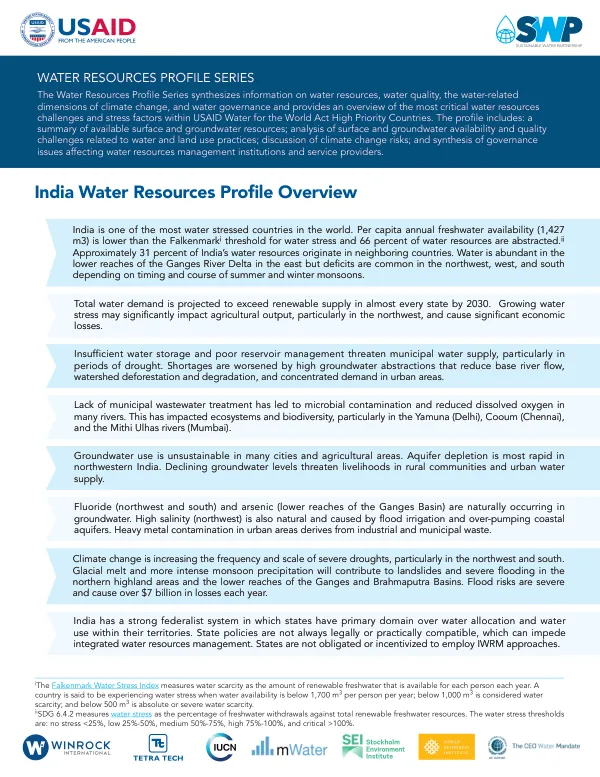
The country's per capita annual freshwater availability is 1,427 m3, which is lower than the Falkenmark threshold for water stress. Approximately 66 percent of India's water resources are abstracted, and 31 percent originate from neighboring countries. Water is abundant in the lower reaches of the Ganges River Delta in the east but is in deficit in the northwest, west, and south, depending on the timing and course of summer and winter monsoons. India has a strong federalist system, with states having primary domain over water allocation and use within their territories. However, state policies are not always legally or practically compatible, which can impede integrated water resources management. Groundwater use is unsustainable in many cities and agricultural areas, with aquifer depletion being most rapid in northwestern India. Declining groundwater levels threaten livelihoods in rural communities and urban water supply. The country's water resources are influenced by the intensity, timing, and duration of summer and winter monsoons. Sixty percent of India's renewable surface water derives from the Ganges and Brahmaputra Basins, which have headwaters in the Himalayas and are part of the transboundary Ganges-Brahmaputra-Meghna Basin. The Ganges is the longest river, flowing across 11 states, and its flows are critical to downstream water users in Pakistan. The Indus Basin does not contribute much to India's total renewable water supply but is essential for downstream water users in Pakistan. India's surface water resources are characterized by high volume and rapid flows into the Bay of Bengal during the summer monsoons, making it challenging to store water. The country has over 1,000 large and medium-sized lakes and reservoirs, with the largest freshwater reservoirs being the Shivaji Sagar, Indira Sagar, and Sardar Sarovar. The Sundarbans wetlands near the Ganges River Delta contain one of the largest mangrove forests in the world. Groundwater resources in India are classified into 14 principal systems, which are further subdivided into 42 major aquifers. Most of these aquifers can be broadly characterized as consolidated and unconsolidated formations. Groundwater availability is more consistent and robust in unconsolidated formations, which contain roughly half of all renewable groundwater in lowland areas, along parts of the eastern coastline, and in a broad band across the Indo-Gangetic Plain in northern India. The country's surface water is used for various purposes, including irrigation, municipal, and industrial uses. Irrigation accounts for 90 percent of all freshwater withdrawals, with over 60 percent of the withdrawals being from surface water. Surface water for irrigation is generally conveyed through extensive canals in the Ganges Basin in the states of Uttar Pradesh, Madhya Pradesh, Haryana, and Bihar. Urban municipal water services rely on surface and groundwater, although surface water abstractions are slightly higher. In rural areas, groundwater is the main water source for domestic use.