USAID DEC
Uncertainty in a Lumped and a Semi-Distributed Model for Discharge Prediction in Ghatshila Catchment
Sign inUSAID DEC
Uncertainty in a Lumped and a Semi-Distributed Model for Discharge Prediction in Ghatshila Catchment
Hydrological simulations of different models have a significant impact on the accuracy of discharge prediction due to the varying model structures.
2018 · 18 pages
Sign in to readA free account is required to download.
Abstract
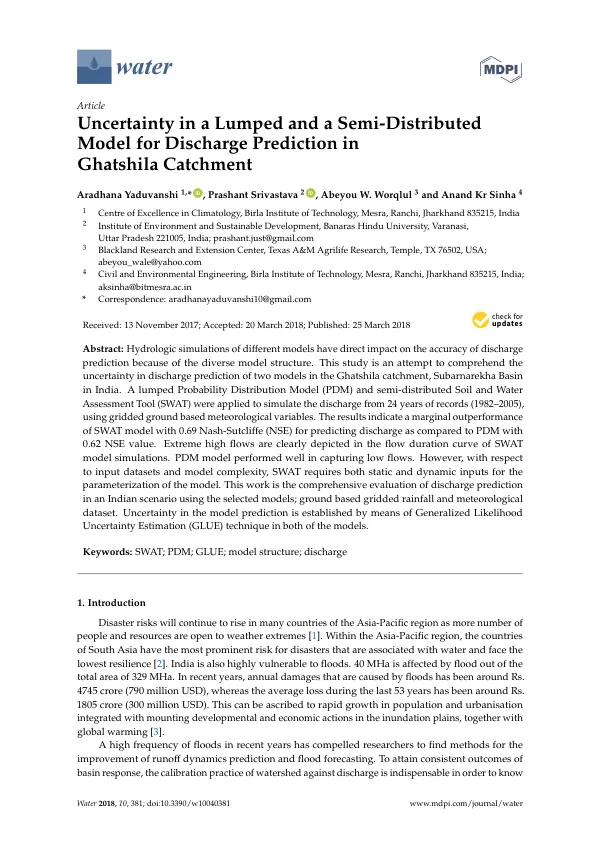
This study aims to comprehend the uncertainty in discharge prediction in the Ghatshila catchment, Subarnarekha Basin in India, using a lumped Probability Distribution Model (PDM) and a semi-distributed model, the Soil and Water Assessment Tool (SWAT). The study utilized 24 years of records (1982-2005) and gridded ground-based meteorological variables to simulate discharge. The results showed a marginal outperformance of the SWAT model with a 0.69 Nash-Sutcliffe Efficiency (NSE) value compared to the PDM with a 0.62 NSE value. The SWAT model simulations depicted extreme high flows in the flow duration curve, while the PDM model performed well in capturing low flows. The study also evaluated the uncertainty in the model prediction using the Generalized Likelihood Uncertainty Estimation (GLUE) technique. The results indicated that the SWAT model required both static and dynamic inputs for parameterization, whereas the PDM model performed well in capturing low flows. The study highlighted the importance of evaluating model uncertainty in hydrological studies, particularly in data-scarce regions. The Ghatshila catchment, located in the Subarnarekha River basin, is a data-scarce region with limited hydro-meteorological data available. The catchment has a tropical climate with a monsoon season from May to October, and an average annual rainfall of 1241 mm. The study utilized hydro-meteorological data from the Government of India's Hydro-meteorological data policy, including gauge height, discharge, silt, and water quality data up to 2012. The study aimed to assess the suitability of hydrological models for predicting discharge in data-scarce regions, quantify parameter uncertainty for discharge prediction using GLUE, and evaluate the variation in the outcomes of two models over the study area. The study utilized a semi-distributed model (SWAT) and a lumped model (PDM) to simulate discharge and evaluate the uncertainty in the model prediction. The SWAT model is a semi-distributed model that requires detailed spatial data for setup and calibration, whereas the PDM is a lumped model that is simpler and easier to implement. The study compared the performance of the two models in predicting discharge in the Ghatshila catchment and evaluated the uncertainty in the model prediction using GLUE. The study found that the SWAT model outperformed the PDM model in predicting discharge, but the PDM model performed well in capturing low flows. The study also highlighted the importance of evaluating model uncertainty in hydrological studies, particularly in data-scarce regions. The results of the study have implications for the development of hydrological models for predicting discharge in data-scarce regions.