USAID
ICT-Enabled Outgrowing Operations: Highlights from Africa
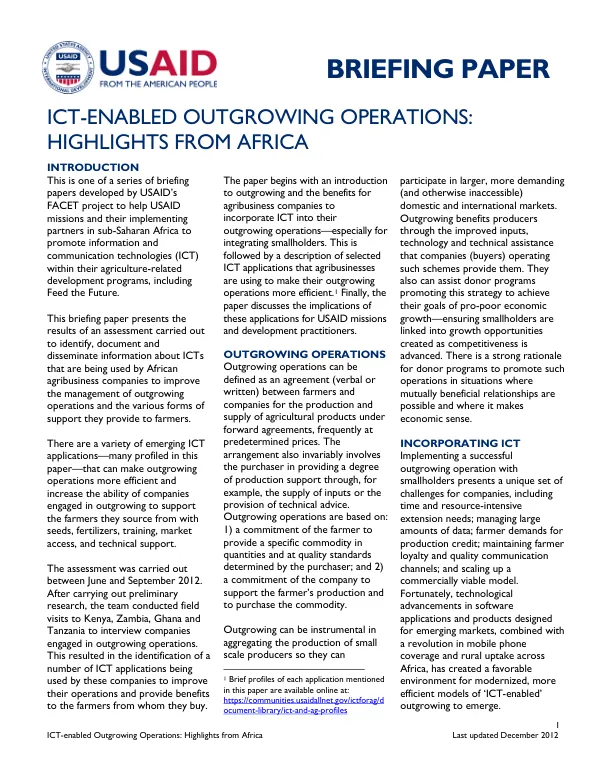
Agricultural development initiatives in Africa have been increasingly incorporating information and communication technologies (ICTs) to improve the management of outgrowing operations and support farmers.
2012 · 6 pages
Sign in to readA free account is required to download.
Abstract
Outgrowing operations involve agreements between farmers and companies for the production and supply of agricultural products under forward agreements, with the company providing production support through inputs or technical advice. The benefits of outgrowing operations include aggregating the production of small-scale producers, enabling them to participate in larger markets, and providing improved inputs, technology, and technical assistance to farmers. Donor programs promoting outgrowing operations can achieve their goals of pro-poor economic growth by linking smallholders into growth opportunities created as competitiveness is advanced. Implementing a successful outgrowing operation with smallholders presents unique challenges for companies, including managing large amounts of data, farmer demands for production credit, and maintaining farmer loyalty and quality communication channels. However, technological advancements in software applications and products designed for emerging markets, combined with increased mobile phone coverage and rural uptake across Africa, have created a favorable environment for modernized, more efficient models of ICT-enabled outgrowing to emerge. Agribusiness companies engaged in outgrowing in Africa are increasingly using a variety of ICT applications to improve efficiencies and support farmers. Many of these examples are highlighted below. Technology is allowing companies to improve production planning, increase product traceability, and manage payments to farmers. Direct deposits for payments to farmers, integrated GPS and GIS, SMS-based database systems for procurement planning, and electronic vouchers to facilitate farmer payments and reduce cash transactions are some of the ICT applications being used by agribusiness companies. Direct deposits for payments to farmers, such as those used by Parmalat in Zambia, can improve the ability of a company to track, monitor, and administer its procurement. Integrated GPS and GIS, such as those used by Geo-Traceability in Ghana, can provide the data and technology platform basis for a range of efficiencies and complementary applications. SMS-based database systems for procurement planning, such as those used by a large Kenyan green bean exporter, can make significant improvements to procurement planning. Automated bulk voice messaging with feedback loop, electronic vouchers to facilitate farmer payments and reduce cash transactions, bulk SMS and radio programs to improve direct communications, supply chain management software, input tracking systems using barcodes, traceability and quality assurance software, and mobile farmer education networks are also being used by agribusiness companies to improve their outgrowing operations and support farmers. These ICT applications can help reduce transaction costs and create positive impact for both companies and producers, as well as others involved in the system. They can also improve the ability of companies to track, monitor, and administer their procurement, and provide improved inputs, technology, and technical assistance to farmers.