MART PROJECT
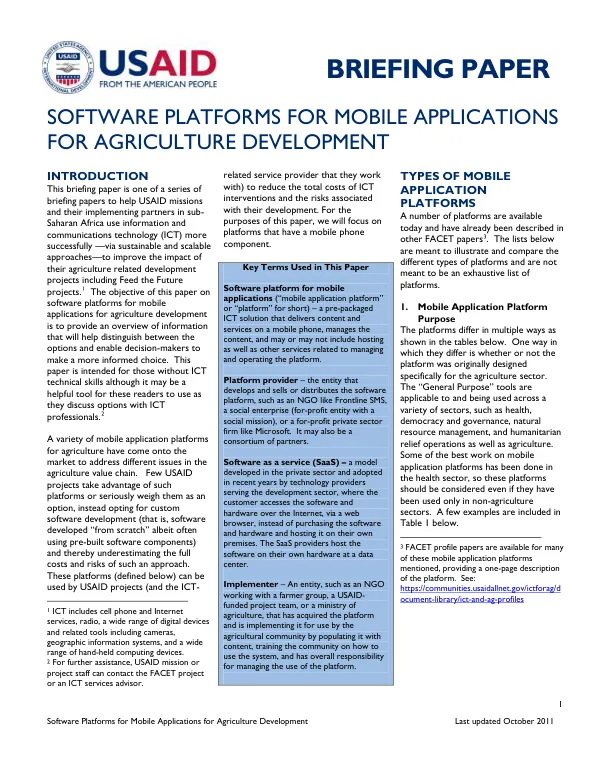
Software Platforms for Mobile Applications for Agriculture Development
Software platforms for mobile applications in agriculture development have become increasingly popular in sub-Saharan Africa.
2011 · 9 pages
Sign in to readA free account is required to download.
Abstract
These platforms aim to improve the impact of agriculture-related development projects, including those funded by USAID's Feed the Future initiative. The objective of this paper is to provide an overview of information that will help distinguish between the options and enable decision-makers to make a more informed choice. A variety of mobile application platforms for agriculture have come onto the market to address different issues in the agriculture value chain. Few USAID projects take advantage of such platforms or seriously weigh them as an option, instead opting for custom software development. These platforms can be used by USAID projects to reduce the total costs of ICT interventions and the risks associated with their development. Key terms used in this paper include software platform for mobile applications, platform provider, software as a service, and implementer. A software platform for mobile applications is a pre-packaged ICT solution that delivers content and services on a mobile phone, manages the content, and may or may not include hosting as well as other services related to managing and operating the platform. Several types of mobile application platforms are available, including general-purpose platforms and agriculture-specific platforms. General-purpose platforms, such as Frontline SMS, DataDyne EpiSurveyor, and Google Trader, are applicable to and being used across a variety of sectors, including health, democracy and governance, natural resource management, and humanitarian relief operations as well as agriculture. These platforms offer functionality that serves a broad need, such as sending text messages to a number of people and receiving text messages from people. Agriculture-specific platforms, such as Souktel – Farm Price SMS Service, Voxiva’s eSoko, and DataDyne Mobile Information Platform (MIP), are designed specifically for the agriculture sector. These platforms provide market price information, mobile-based agriculture market information exchange, and farm extension-type services. Examples of agriculture-specific platforms include Esoko, Google Farmer’s Friend, and KenCall’s M-Kilimo, which provide market information, farm extension services, and voice-based agriculture information services. The platforms differ in multiple ways, including whether or not they were originally designed specifically for the agriculture sector. Some platforms, such as Nokia Life Tools (NLT), Reuters Market Light (RML), and TechnoBrain BioReg GRS, are designed specifically for the agriculture sector and provide mobile information services, market and agriculture information systems, and biometrically-registered grower registration systems. These platforms offer pre-built functionality for specific needs like agriculture market prices for multiple varieties of a crop. Overall, software platforms for mobile applications in agriculture development offer a range of benefits, including reduced costs and risks, improved impact, and increased efficiency. By understanding the different types of platforms available, decision-makers can make a more informed choice and select the platform that best meets their needs.
Related documents