USAID DEC
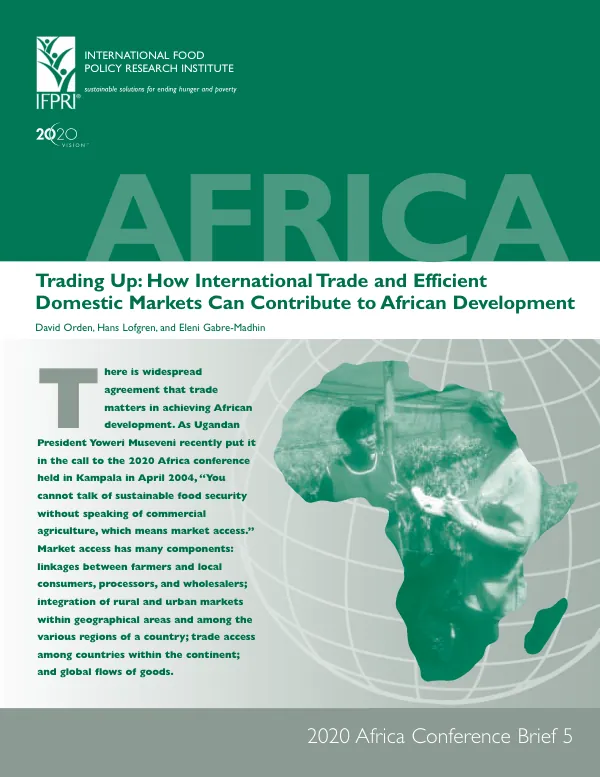
Trading Up: How International Trade and Efficient Domestic Markets Can Contribute to African Development
Sign inINTERNATIONAL FOOD AND POLICY RESEARCH INSTITUTE
Trading Up: How International Trade and Efficient Domestic Markets Can Contribute to African Development
Market access has been identified as a crucial component in achieving African development.
2020 · 4 pages
Sign in to readA free account is required to download.
Abstract
This concept encompasses linkages between farmers and local consumers, processors, and wholesalers, as well as integration of rural and urban markets within geographical areas and among various regions of a country. Trade access among countries within the continent and global flows of goods also play significant roles in market access. The World Trade Organization (WTO) has been a key player in the Doha Round of trade negotiations, which was inaugurated in November 2001. A central issue in these negotiations is the content of agreements relating to agriculture. Research conducted by the International Food Policy Research Institute (IFPRI) has provided specific figures on the cost of subsidies and border protection by wealthy countries, which inflict harm on agriculture in developing countries. The support and trade-protection measures of developed countries are estimated to reduce net agricultural exports of developing countries by nearly US$40 billion, resulting in a loss in annual income to agriculture and agro-industries of US$24 billion. For Sub-Saharan Africa (SSA), the value of net agricultural exports might increase by one-third, adding US$2 billion to agricultural GDP, if developed-country support policies and trade barriers were abandoned. However, achieving agricultural policy reform is not easy, as farm groups remain powerful lobbies in developed countries, and farm support and trade policies are shrouded in complexities. During 2003, proposals for partial reform put forward jointly by the European Union (EU) and the United States were judged to accomplish too little by a coalition of developing countries, with only South Africa joining in this critique. In the initial jockeying for positions in the Doha negotiations through May 2004, there has been more heat than light. Any agriculture-related accomplishments in the Doha Round will depend on a complex interplay of economic and political forces over the next several years. Articulating specific strategic steps is an ongoing process, but guidelines for progress emerge from an examination of the options available. In the Doha negotiations, African policymakers should focus on the developed-country policies that directly affect trade, such as tariffs and tariff-rate quotas or export subsidies, and therefore do the most direct harm. The domestic farm support policies of the developed countries can also distort markets, but there are differences in the degree of damage caused by alternative policy instruments. It is also crucial that any agreement on core trade issues be accompanied by efforts to help African countries break through the bottlenecks in their domestic financial, human, and institutional capacity that prevent them from benefiting more fully from international trade. There are linkages among products and policies that make it difficult to focus negotiations on only one commodity or one policy. Additional market-access issues arise concerning the application of measures addressing sanitary and phytosanitary (SPS) and other technical barriers to trade (TBT) related to food quality standards and regulations. In the Doha Round, discussions have also addressed extending the protection of geographical indications for agricultural products, as favored by the EU in particular. These issues have increased in importance as trade in high-value agricultural products has grown and as the related WTO agreements have been implemented. While providing some international guidance, the WTO disciplines on SPS and other technical barriers are modest. Within the WTO's SPS agreement, countries are restrained from imposing sanitary and phytosanitary barriers without scientific evidence of risk. However, they are not required to weigh the economic costs and benefits, either in their own domestic markets or to their trade partners, of SPS regulations for which small risk justifications can be found. Likewise, the TBT agreement provides only limited constraints on measures adopted to address other regulatory objectives that a country deems legitimate. Regional trade agreements (RTAs) have also been identified as a key component in increasing market access in SSA. There are 14 RTAs between African nations, yet trade remains fragmented among member nations because in some cases the RTAs have partially overlapping memberships and in others conflicting objectives. Few of the RTAs have achieved substantial reductions in tariffs. An effective regional agreement would reduce tariff and nontariff barriers to trade and stimulate economic growth. Researchers at IFPRI have identified more than 250 agricultural goods for which one or more SSA countries has a comparative advantage. Nearly one-third are goods, including such staples as livestock and livestock products, cereals, roots and tubers, and peas and beans, for which other African countries have a comparative disadvantage and are importers. Intraregional trade offers opportunities that complement trade with countries outside of the region. Increasing intraregional trade would provide opportunities for the rural poor and could help to partially alleviate Africa's food security problems. Within the multilateral and regional framework, individual nations must decide on their own policies toward trade and national markets. Analysis shows what is at stake when developing countries reduce their own trade barriers in conjunction with the removal of subsidies and trade barriers by developed countries. The research indicates that the gain in net agricultural exports and agricultural and agro-industry income in Africa and other developing countries would be somewhat reduced compared with the gain expected if the developing countries