JHPIEGO
Identifying Needs for Strengthening Health Professionals’ Regulation in Ethiopia
Health professionals' regulation in Ethiopia is a critical component of ensuring fitness to practice and protecting public safety.
2015 · 1 pages
Sign in to readA free account is required to download.
Abstract
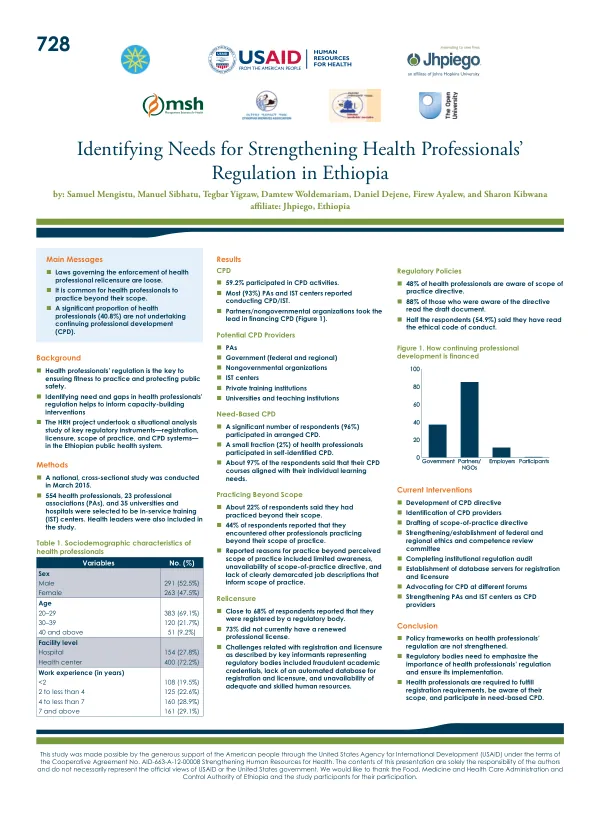
The regulation of health professionals is key to preventing unqualified individuals from practicing and to maintaining high standards of care. However, the current laws governing the enforcement of health professional relicensure are loose, and it is common for health professionals to practice beyond their scope. A significant proportion of health professionals in Ethiopia are not undertaking continuing professional development (CPD), with only 59.2% participating in CPD activities. Most professional associations (PAs) and in-service training (IST) centers reported conducting CPD, with partners and nongovernmental organizations taking the lead in financing CPD. Potential CPD providers include PAs, government, nongovernmental organizations, IST centers, private training institutions, and universities and teaching institutions. The majority of health professionals in Ethiopia participate in arranged CPD, with 96% of respondents participating in arranged CPD and 97% of respondents saying that their CPD courses aligned with their individual learning needs. However, a small fraction of health professionals participate in self-identified CPD, and some reported practicing beyond their scope. The reasons for practicing beyond the perceived scope of practice included limited awareness, unavailability of scope-of-practice directive, and lack of clearly demarcated job descriptions that inform scope of practice. Relicensure is also a critical component of health professionals' regulation in Ethiopia. Close to 68% of respondents reported that they were registered by a regulatory body, but 73% did not currently have a renewed professional license. Challenges related to registration and licensure included fraudulent academic credentials, lack of an automated database for registration and licensure, and unavailability of adequate and skilled human resources. The current policy frameworks on health professionals' regulation in Ethiopia are not strengthened, and regulatory bodies need to emphasize the importance of health professionals' regulation and ensure its implementation. Health professionals are required to fulfill registration requirements, be aware of their scope, and participate in need-based CPD. Current interventions aimed at strengthening health professionals' regulation in Ethiopia include the development of a CPD directive, identification of CPD providers, drafting of a scope-of-practice directive, and strengthening of federal and regional ethics and competence review committees. A national, cross-sectional study was conducted in March 2015 to identify the need and gaps in health professionals' regulation in the Ethiopian public health system. The study involved 554 health professionals, 23 professional associations, and 35 universities and hospitals. The sociodemographic characteristics of health professionals in the study showed that 52.5% were male, 47.5% were female, and the majority were between 20 and 29 years old. The study also found that 48% of health professionals were aware of the scope of practice directive, and 88% of those who were aware of the directive read the draft document.