USAID DEC
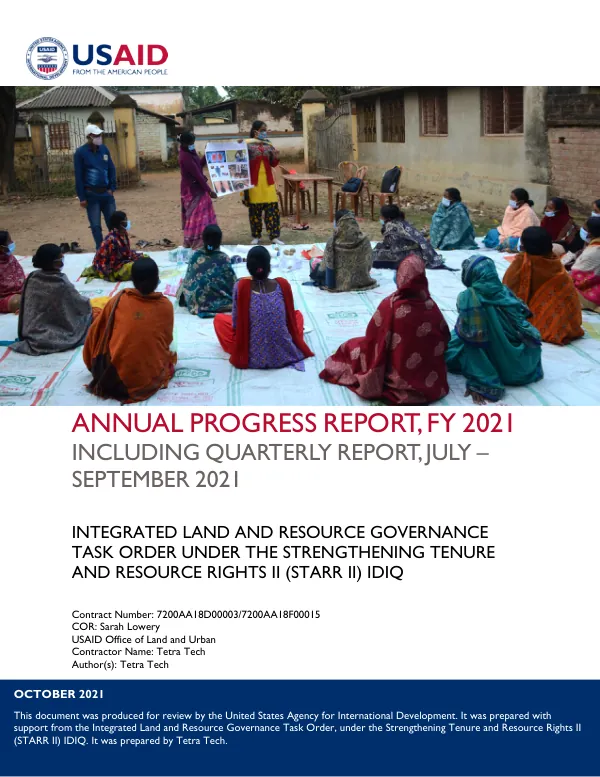
ILRG Annual Progress Report, FY 2021: Including Quarterly Report, July - September 2021
Sign inTETRA TECH
ILRG Annual Progress Report, FY 2021: Including Quarterly Report, July - September 2021
The Integrated Land and Resource Governance (ILRG) Task Order under the Strengthening Tenure and Resource Rights II (STARR II) IDIQ is a USAID-funded project aimed at improving land governance and resource management in several countries.
2021 · 79 pages
Sign in to readA free account is required to download.
Abstract
The project is implemented by Tetra Tech, with a focus on supporting the development of capacity development indicators and tools, mobile approaches to secure tenure, and policy support. In Mozambique, the project focused on management and administration, programming activities, policy support, gender considerations, and significant implementation problems and resolution. The project implemented activities to coordinate, collaborate, and share information, with a focus on improving natural resource management and advancing community-based planning and governance. In Zambia, the project supported the development of land policy and regulations, improved natural resource management, and advanced community-based planning and governance. The project also supported indigenous peoples, with a focus on land governance and community land use planning. In Ghana, the project supported deforestation-free cocoa production, with a focus on land governance, community land use planning, cost recovery farm-level tenure documentation, farm rehabilitation services, and tree tenure. In India, the project supported women's economic empowerment and equality, with a focus on land rights and agricultural engagement. The project also implemented activities in several other countries, including Liberia, Malawi, and the Democratic Republic of Congo. In Liberia, the project supported community land protection, while in Malawi, the project supported women's economic empowerment through the cocoa sector partnership. In the Democratic Republic of Congo, the project supported conflict mapping and monitoring around mineral supply chains. The project also implemented activities to support the development of capacity development indicators and tools, mobile approaches to secure tenure, and policy support. The project also supported the development of a sub-national assessment of land governance, with a focus on improving land governance and resource management. The project's performance was evaluated through the use of project-specific performance indicators, which included measures of project implementation, capacity development, and policy support. The project also implemented environmental mitigation and monitoring measures, with a focus on minimizing the project's environmental impact. The project's success was demonstrated through the implementation of several success stories, including the development of a community land protection program in Liberia and the implementation of a deforestation-free cocoa production program in Ghana. The project also supported the development of a project brief, which outlined the project's objectives, scope, and implementation plan. The project's communications and learning activities included the development of a project website, social media accounts, and a newsletter. The project also implemented a learning and knowledge management system, which included the development of a knowledge management plan and the implementation of a knowledge management system. Overall, the ILRG Task Order under the STARR II IDIQ project made significant progress in improving land governance and resource management in several countries. The project's success was demonstrated through the implementation of several success stories and the development of a project brief. The project's communications and learning activities also supported the development of a project website, social media accounts, and a newsletter.