TETRA TECH
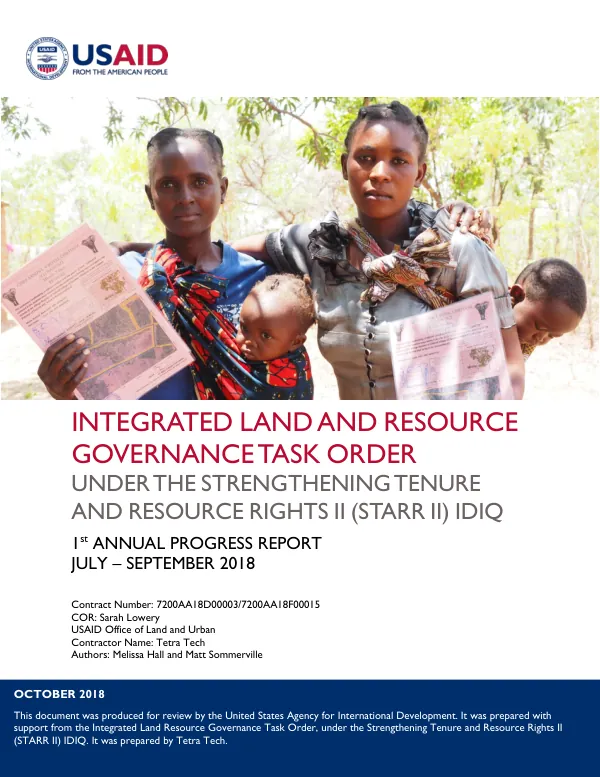
ILRG First Annual Progress Report
The Integrated Land and Resource Governance (ILRG) task order under the Strengthening Tenure and Resource Rights II (STARR II) Indefinite Delivery/Indefinite Quantity (IDIQ) contract provides support to the United States Agency for International Development's (USAID) Land and Urban Office in the Bureau for Economic Growth, Education, and Environment (E3/LU).
2018 · 20 pages
Sign in to readA free account is required to download.
Abstract
ILRG develops and implements targeted interventions in select USAID presence and non-presence countries, providing technical assistance to improve land and resource governance, strengthen property rights, and build resilient livelihoods as the foundation for stability, resilience, and strong economic growth. The TO has four primary objectives that assist in ending extreme poverty: to increase inclusive economic growth, resilience, and food security; to provide a foundation for sustainable natural resource management and biodiversity conservation; to promote good governance, conflict mitigation, and disaster mitigation and relief; and to empower women and other vulnerable populations. To achieve these objectives, the TO works collaboratively with USAID, communities, civil society, host country governments, academia, and the private sector through four inter-related components: Component 1, Support the development of inclusive land and property rights laws and policies; Component 2, Assist law and policy implementation, including clarifying, documenting, registering, and administering rights to land and resources; Component 3, Support the capacity of local institutions to administer and secure equitable land and resource governance; and Component 4, Facilitate responsible land-based investment that creates optimized outcomes for communities, investors, and the public. The ILRG contract has two mechanisms for providing support on land and natural resource governance. Under the term portion of the contract, the project implements technical assistance in Mozambique and Zambia, with the potential to also provide support in Mexico. Work in Mozambique initially focuses on policy engagement, work with customary institutions, dispute resolution, and support for communities to strengthen their land rights and be better prepared to make decisions around land use, while work in Zambia initially includes support to land policy, customary land administration and service delivery, and natural resource governance and tenure around protected areas. The ILRG TO was awarded to the Tetra Tech consortium on July 27, 2018, and this report covers the period from July 27, 2018 to September 30, 2018. Activities in this period were largely focused on initial project start-up, discussions with USAID, and work planning. In August, the ILRG team met with the E3/LU team in Washington, DC to hold initial discussions on the contract, activities in Mozambique and Zambia, and opportunities under the completion portion of the budget. Additionally, the E3/LU team facilitated meetings with other USAID/Washington offices and bureaus to discuss potential collaboration with ILRG. In September, work planning continued with in-country meetings in Mozambique and Zambia, in which representatives from ILRG and E3/LU met with local stakeholders, including host country government, civil society organizations, and the private sector. In addition, the ILRG and E3/LU teams met with USAID mission staff in both countries to present activity options for going forward and solicit feedback on how well potential activities aligned with mission strategic priorities. In Zambia, the project also engaged several short-term consultants to assist with technical and administrative start-up, and the Chief of Party mobilized to Zambia for the first two years of the project to allow more direct engagement and oversight of activities. Two completion activities were launched in this period. The first is the organization of a consultation in Washington on USAID's draft Policy on Indigenous Peoples' Issues to be held in November 2018. The ILRG team worked closely with USAID to draft an agenda and identify a facilitator, and ILRG also began work on logistical components like sending invitations and organizing a venue and simultaneous interpretation services for the consultation workshop. The second completion activity is the expansion of responsible investment pilot work originally implemented under the Tenure and Global Climate Change (TGCC) program. The activity under ILRG will work with private sector partners to address land tenure and natural resource governance issues in Ghana.