CDC
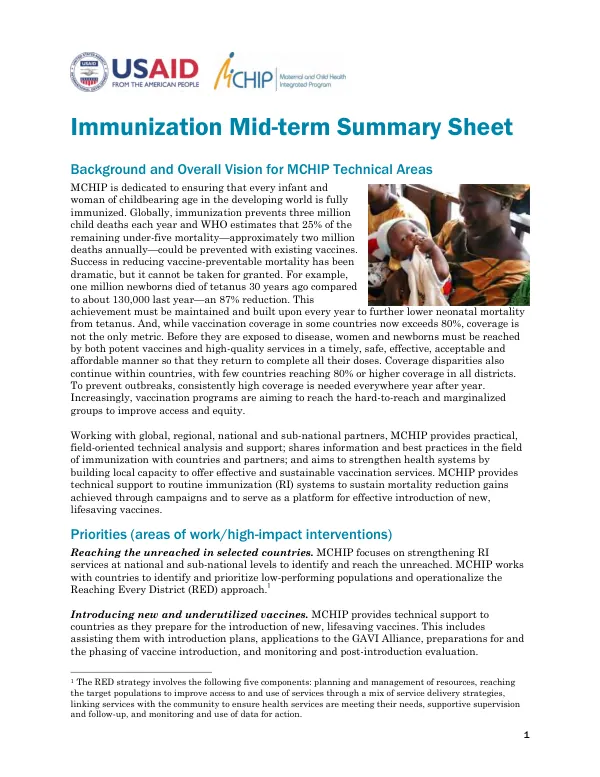
Immunization Mid-term Summary Sheet
MCHIP is dedicated to ensuring that every infant and woman of childbearing age in the developing world is fully immunized.
2011 · 6 pages
Sign in to readA free account is required to download.
Abstract
Globally, immunization prevents three million child deaths each year, and the World Health Organization estimates that 25% of the remaining under-five mortality, approximately two million deaths annually, could be prevented with existing vaccines. Success in reducing vaccine-preventable mortality has been dramatic, with a 87% reduction in neonatal tetanus deaths over the past 30 years. MCHIP provides practical, field-oriented technical analysis and support to global, regional, national, and sub-national partners. The organization shares information and best practices in the field of immunization with countries and partners, aiming to strengthen health systems by building local capacity to offer effective and sustainable vaccination services. MCHIP focuses on three key priorities: reaching the unreached in selected countries, introducing new and underutilized vaccines, and supporting vaccine-preventable disease interventions. To reach the unreached, MCHIP works with countries to identify and prioritize low-performing populations and operationalize the Reaching Every District (RED) approach. This strategy involves planning and management of resources, reaching target populations to improve access to and use of services, linking services with the community, supportive supervision and follow-up, and monitoring and use of data for action. MCHIP also provides technical support to countries as they prepare for the introduction of new, lifesaving vaccines, including assistance with introduction plans, applications to the GAVI Alliance, and monitoring and post-introduction evaluation. MCHIP has contributed significantly to global and regional policymaking and technical leadership, advancing immunization programming through engagement in global policymaking processes. The organization has also published articles in peer-reviewed journals, given keynote presentations at global and regional immunization meetings, and contributed to global protocols and program learning. In addition, MCHIP has provided technical assistance to five countries for new vaccine introduction, including the Democratic Republic of Congo, Kenya, Rwanda, Tanzania, and Zimbabwe. MCHIP works closely with international organizations and links its country programming to important global and regional initiatives, such as the GAVI Alliance, the WHO/UNICEF Global Immunization Vision and Strategy (GIVS), the Global Polio Eradication Initiative, and the Measles Initiative. The organization is currently working in several countries, including the Democratic Republic of Congo, India, and Kenya, to strengthen routine immunization systems and build the capacity of health providers and immunization program managers to provide high-quality services. In the Democratic Republic of Congo, MCHIP is building on successes and lessons learned over the past 14 years, providing technical support to the Ministry of Health, bilateral partners, and other stakeholders to strengthen policy and immunization program management and guidance at all levels. The project targets health zones with large numbers of unimmunized or partially immunized children, documents promising practices, raises awareness, and advocates for greater attention to and investment in routine immunization. In India, MCHIP works in two states, Uttar Pradesh and Jharkhand, and at the national level to strengthen routine immunization systems and build the capacity of health providers and immunization program managers to provide high-quality services. In Kenya, MCHIP works to strengthen routine immunization through technical assistance with the Division of Vaccines and Immunization and its partners, particularly those working on immunization within the Child Health Committee. The organization also provides immunization technical support to Nyanza and Western provinces and in select districts, including RED training and on-the-job capacity building, improving immunization coverage and equity.
Related documents