USAID DEC
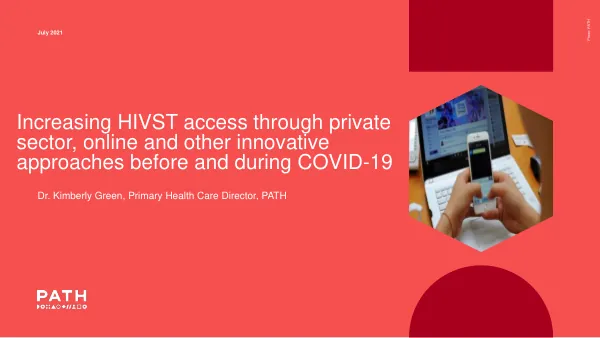
Increasing HIVST Access through Private Sector, Online and Other Innovative Approaches before and during COVID-19
Sign inPATH
Increasing HIVST Access through Private Sector, Online and Other Innovative Approaches before and during COVID-19
HIV self-testing (HIVST) access has been increased through private sector, online, and other innovative approaches before and during the COVID-19 pandemic.
2021 · 22 pages
Sign in to readA free account is required to download.
Abstract
Key populations, including men who have sex with men (MSM), adolescent girls and young women (AGYW), and other vulnerable groups, have expressed a strong preference for convenient, confidential, and accessible HIVST services. Convenience, confidentiality, and choice are key factors in the preferred place to seek HIVST among key populations in Vietnam. Online platforms have been identified as a preferred option, offering the convenience of self-testing and complete confidentiality. In Nigeria, young women have expressed a preference for pharmacy-based HIVST services, citing reduced chances of discrimination and stigmatization. Implementation of HIVST services has been expanded to include online ordering and home delivery, ensuring continued access to HIVST kits during the pandemic. In Vietnam, the HIVST 3.0 program has utilized online platforms to offer multiple entry points to securing a HIVST test, other HIV services, and COVID-19 information. The program has also leveraged social media, including Facebook and WhatsApp, to promote HIVST services and provide individualized access to services. In Kenya, virtual safe spaces have been created to provide group education on HIVST, PrEP, COVID-19, and other information. Home-delivered HIVST kits have been requested via phone or virtual safe space platform, accompanied by referrals to facilities for those who are reactive. The program has facilitated PrEP and family planning initiation among AGYW. Data from various studies and programs has shown a significant increase in HIVST reach before and during the COVID-19 pandemic. In Vietnam, the HIVST 3.0 program has reported a high level of engagement, with 61% of MSM completing risk assessments and 52% having never tested for HIV before. In Kenya, 1,170 HIVST kits were requested and distributed to AGYW via virtual safe spaces. Implementation of HIVST services has been expanded to include online platforms, virtual safe spaces, and home delivery. These innovative approaches have increased access to HIVST services, particularly among key populations. The data suggests that online platforms and virtual safe spaces can offer convenience, confidentiality, and choice, increasing the likelihood of HIVST adoption and use.
Related documents