THE WORLD RESOURCES INSTITUTE
The Corporate Ecosystem Services Review Case Study: Votorantim Industrial
Votorantim Industrial, a large Brazilian holding company, has prioritized biodiversity and ecosystem services as one of nine key sustainability issues since 2009.
2013 · 5 pages
Sign in to readA free account is required to download.
Abstract
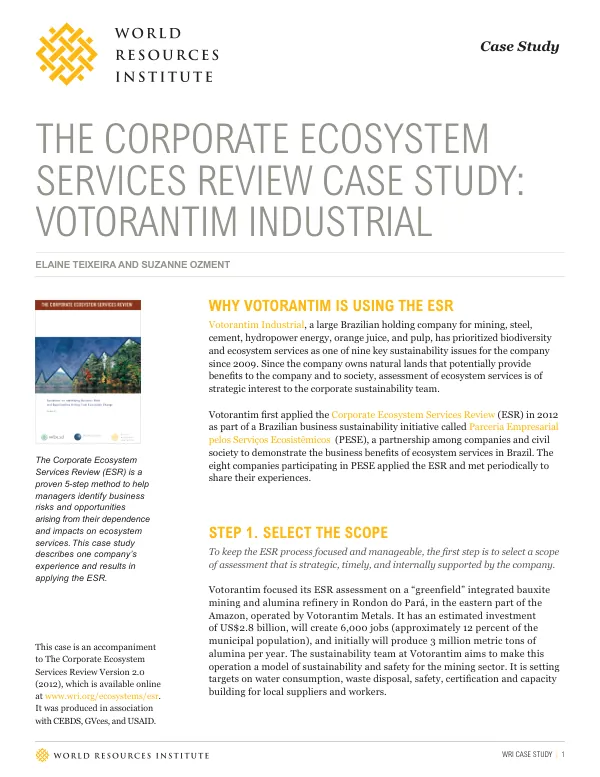
The company's corporate sustainability team has applied the Corporate Ecosystem Services Review (ESR) to assess ecosystem services and identify business risks and opportunities. The ESR process involves five steps: selecting the scope, identifying priority ecosystem services, analyzing trends in priority ecosystem services, identifying business risks and opportunities, and developing a plan to address these risks and opportunities. The company's ESR assessment focused on a "greenfield" integrated bauxite mining and alumina refinery in Rondon do Pará, in the eastern part of the Amazon. The operation is expected to create 6,000 jobs and produce 3 million metric tons of alumina per year. The sustainability team aims to make this operation a model of sustainability and safety for the mining sector, setting targets on water consumption, waste disposal, safety, certification, and capacity building for local suppliers and workers. The ESR team prioritized four ecosystem services: sand, wood, freshwater, and waste treatment. Sand is a fundamental input to constructing the structures, and the company's environmental policy requires all sand extraction to be licensed and authorized by a governmental environmental agency. However, the team found that there was a scarcity of certified-sustainable sand and timber in the region, with almost all sand sold in Rondon do Pará currently coming from illegal extraction. The analysis of trends in priority ecosystem services revealed that the region has a history of natural resource extraction, leading to depleted ecosystem services. The city lacks a local environmental agency, and there is a lack of information on the ecological implications of natural resources extraction in the region. The ESR team identified operational risks, including the scarcity of certified-sustainable and legal wood and sand, as well as regulatory and reputational risks associated with buying allegedly certified wood and sand. The ESR process also identified opportunities for Votorantim Metals to work with the government to ensure protection and sustainable management of ecosystem services in the region. The company can encourage and support the city to invest in creating amenities such as a licensed landfill and other infrastructure, and help local wood and sand suppliers become licensed. By addressing these risks and opportunities, Votorantim Metals can realize its sustainability goals and contribute to the sustainable development of the region. The ESR assessment highlighted the importance of understanding the conditions and trends in ecosystem services to inform business decisions. The company's experience demonstrates the value of applying the ESR process to identify business risks and opportunities and develop a plan to address them. By prioritizing ecosystem services and working with stakeholders, Votorantim Metals can minimize its environmental impacts and contribute to the sustainable development of the region. The ESR process also revealed the need for more research on the ecological implications of natural resources extraction in the region. The lack of information on the impact of sand extraction on the river and the condition of ecosystem services in the region highlights the importance of conducting further studies to inform business decisions. By investing in research and development, Votorantim Metals can better understand the ecosystem services on which it relies and make more informed decisions to minimize its environmental impacts. In conclusion, the ESR assessment of Votorantim Industrial's "greenfield" integrated bauxite mining and alumina refinery in Rondon do Pará has identified key ecosystem services, business risks, and opportunities. The company's experience demonstrates the value of applying the ESR process to inform business decisions and contribute to the sustainable development of the region. By prioritizing ecosystem services and working with stakeholders, Votorantim Metals can minimize its environmental impacts and contribute to the sustainable development of the region.