USAID DEC
Impact Brief: Democratic Republic of the Congo--Saving and Improving Lives Through Increased Access to Contraceptives, September 2014
Sign inMARIE STOPES INTERNATIONAL
Impact Brief: Democratic Republic of the Congo--Saving and Improving Lives Through Increased Access to Contraceptives, September 2014
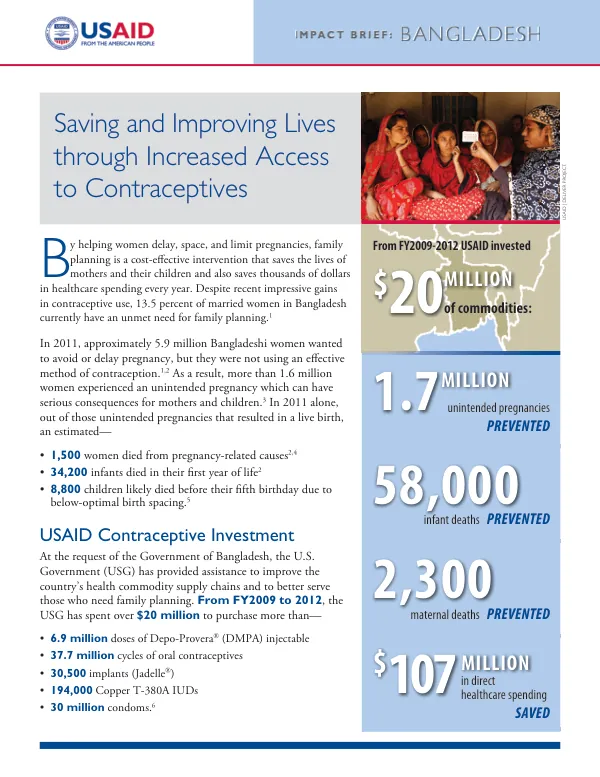
The Democratic Republic of the Congo (DRC) has a significant unmet need for family planning, with 26.9 percent of all women in the country currently lacking access to effective contraceptive methods.
2014 · 2 pages
Sign in to readA free account is required to download.
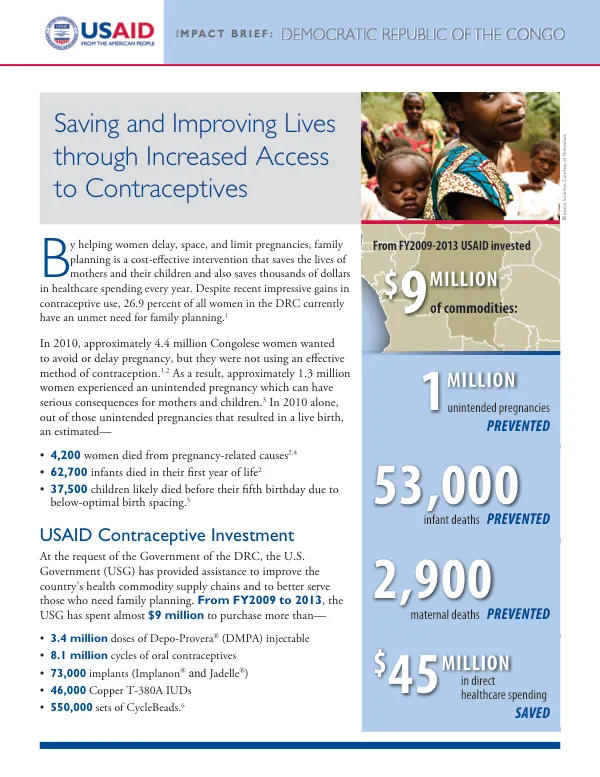
Abstract
This unmet need has serious consequences for mothers and children, with an estimated 1.3 million women experiencing unintended pregnancies in 2010. These unintended pregnancies can lead to maternal deaths, infant deaths, and child deaths due to below-optimal birth spacing. According to the World Health Organization, in 2010, an estimated 4,200 women died from pregnancy-related causes, 62,700 infants died in their first year of life, and 37,500 children likely died before their fifth birthday due to below-optimal birth spacing. The U.S. Government, through the U.S. Agency for International Development (USAID), has provided assistance to improve the country's health commodity supply chains and to better serve those who need family planning. From FY2009 to 2013, the USG spent almost $9 million to purchase more than 3.4 million doses of Depo-Provera injectable, 8.1 million cycles of oral contraceptives, 73,000 implants, 46,000 Copper T-380A IUDs, and 550,000 sets of CycleBeads. This investment had a significant impact, with USAID-funded contraceptives preventing approximately 971,000 unintended pregnancies, 121,000 induced abortions, 53,000 infant deaths, 32,000 child deaths due to improved birth spacing, and 2,900 maternal deaths. The estimated impact of USAID contraceptive commodity support in the DRC, by fiscal year, is as follows: couple-years of protection generated by commodities shipped, unintended pregnancies averted, unintended live births averted, abortions averted, infant deaths averted, child deaths averted due to improved birth spacing, and maternal deaths averted. The total estimated impact from FY2009 to 2013 is 2.7 million couple-years of protection, 970,900 unintended pregnancies averted, 680,400 unintended live births averted, 121,200 abortions averted, 53,400 infant deaths averted, 32,400 child deaths averted due to improved birth spacing, and 2,900 maternal deaths averted. The direct healthcare costs savings in the DRC from FY2009 to 2013 are estimated to be $44.7 million. USAID is a leader in efforts to meet the reproductive health needs of women in the DRC and other countries in the developing world. Improving access to modern methods of contraception is crucial to meeting these needs. Continued USAID investment in procuring contraceptives and strengthening the national supply chain systems is essential to increasing access and reducing the unmet need for family planning.