DAI GLOBAL, LLC
USAID IGA Annual Report 2020
The Integrated Governance Activity (IGA) is a five-year USAID-funded program designed to create a good governance framework and local capacity necessary for improved delivery of key services, particularly for health, education, and economic development.
2020 · 140 pages
Sign in to readA free account is required to download.
Abstract
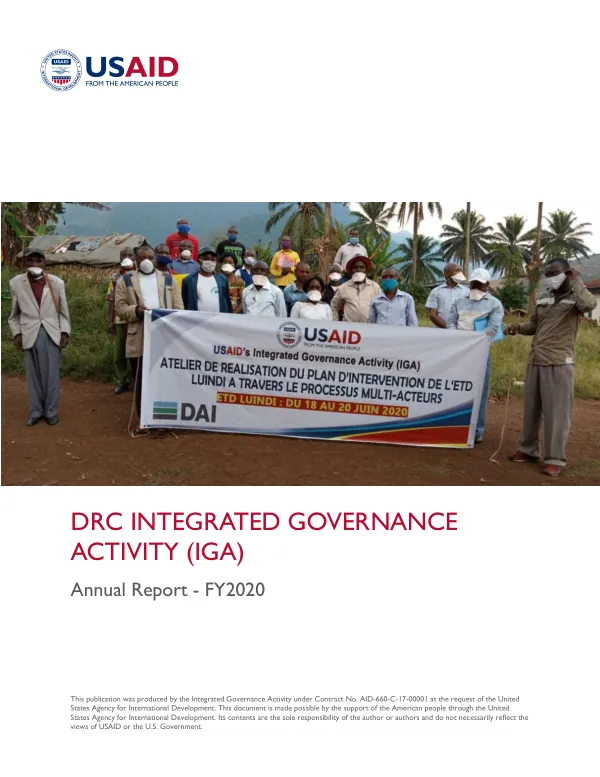
The program is implemented in five provinces across the Democratic Republic of Congo (DRC) – Kasai Central, Kasai Oriental, Lualaba, Haut Katanga, and Sud Kivu – and the territory of Walikali. The program's specific objectives are built around the interaction of the governance cycle, focusing on strengthening the capacity of select government institutions, targeted subnational entities collaborating with citizens for more effective development, and increasing citizen demand for accountable, transparent, participatory services. During FY20, IGA was able to resume activities with DRC government institutions and expand its geographic reach. The project worked closely with USAID to align geographic priorities and modify the project's scope, permitting IGA to extend its influence beyond the boundaries of the original target provinces. As a result, IGA began providing assistance to decentralized territorial entities (ETDs) deemed of high strategic importance by the USAID Mission. These ETDs include those receiving royalties from commercial mining companies and others in Ebola-affected areas. IGA implemented numerous priority activities during the period, including the strengthening of ETD financial management, training of local tax collectors, and development of support networks to promote citizen participation in budgeting and citizen control. The project also supported joint ETD/civil society budget committees and expanded the number of ETD partners from 18 to 40. IGA facilitated the formulation of a five-year local development plan and assisted the newly-selected ETD staff along with other stakeholders to work together preparing local participatory budgets. Other activities implemented by IGA during the period included developing a cadre of school government auditors to conduct audits in partner schools, strengthening their financial management and increasing transparency. The project also provided assistance to a network of civil society organizations (CSOs) to enable them to produce a handbook for ETDs on how to plan and account for mining royalties. Additionally, IGA introduced community scorecard activities resulting in recovery plans for public facilities and strengthening their oversight committees. The program also commenced its grants program by soliciting proposals from partner CSOs. Another IGA activity completed this year was a political economy analysis (PEA) study of government relationships in North and South Kivu with particular attention to the health and education sectors. The objectives of the PEA were to analyze the dynamics and interactions between the national government and new centers of political power at the provincial level, and how the technical and financial arms of central government affect the decentralized bodies in the areas of education and health. The study aimed to identify the niches where the interventions and support of USAID IGA are likely to make these structures more effective, particularly in the education and health sectors. IGA's efforts during FY20 were hindered by the COVID-19 pandemic, which led to the restriction of passenger flights and gatherings. However, the program was able to adapt and continue implementing activities, including the strengthening of ETD financial management, training of local tax collectors, and development of support networks to promote citizen participation in budgeting and citizen control. Despite the challenges posed by the pandemic, IGA was able to make significant progress in achieving its objectives and contributing to the improved delivery of key services in the DRC.
Related documents