SPRING
Impact Evaluation Endline Report: Totohealth
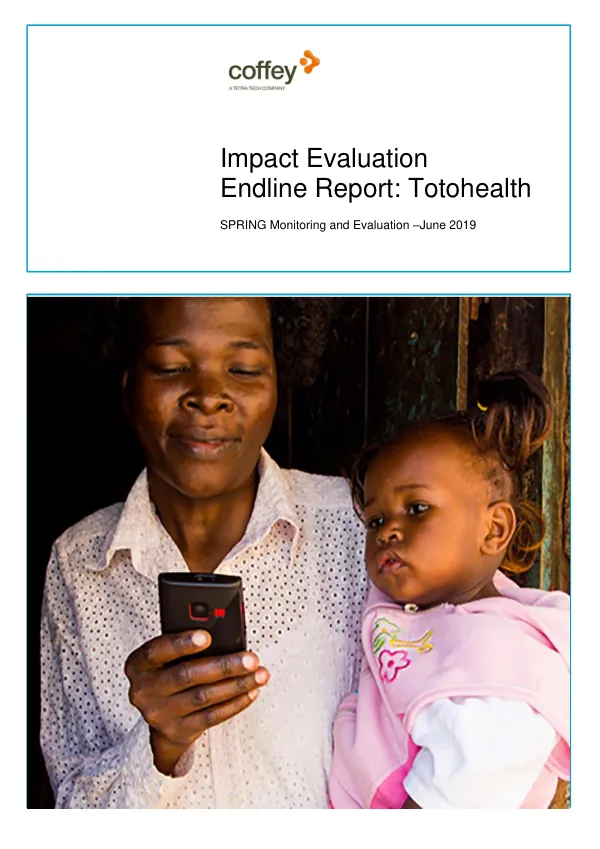
The Totohealth service provider was established in Kenya to offer maternal and child health advice and support to expectant and new mothers through mobile SMS technology.
2019 · 131 pages
Sign in to readA free account is required to download.
Abstract
The service aimed to reduce maternal and child mortality and detect developmental abnormalities in early stages of childhood. With the support of SPRING, Totohealth developed a new prototype, known as the Totohealth SPRING prototype, which provided targeted MCH information to adolescent girls. The core function of the prototype was to provide adolescent-specific MCH information to young mothers during pregnancy and for the first two years of their child's lives. The Totohealth SPRING prototype provided young girls with information on antenatal care, safe delivery, pregnancy, immunisation, nutrition, and breastfeeding, and child health. The primary aim was that these young mothers would experience positive changes in their MCH knowledge, attitudes, and practices. With SPRING funding and business development support, Totohealth developed the adolescent-specific SMS content as well as a formal helpdesk support. Additionally, SPRING supported Totohealth's general business development and provided technical assistance in the design and marketing of a maternity product, the Totobag. The impact evaluation of Totohealth used contribution analysis, a theory-based evaluation approach, to draw conclusions about the impact of and learning for the SPRING programme. The evaluation questions focused on the extent to which access to products, services, and business opportunities provided by SPRING businesses resulted in improved outcomes linked to economic empowerment, health, and well-being for adolescent girls. The evaluation methodology used qualitative data collection tools, including a Theory of Change (ToC) and Relevant Explanation Finder (REF), to map out and analyse mechanisms of change, potential influencing factors, and alternative explanations that may influence outcomes. The key results of the impact evaluation showed varying degrees of impact across girls' MCH knowledge, attitudes, proactive health-seeking behaviour, and well-being and confidence. Overall, Totohealth had a positive impact on health-seeking behaviour, but this was confounded by several internal and external factors, including barriers to girls' improving knowledge, attitudes, and health-seeking practicing behaviours. Despite these barriers, the endline study showed that Totohealth contributed significantly to girls' MCH knowledge. However, Totohealth's impact was more fragmented in changing MCH attitudes and behaviours than in increasing MCH knowledge. The evaluation found that Totohealth's impact on girls' own well-being and confidence was limited to areas such as breastfeeding, nutrition, and child development. The primary feature of Totohealth was to provide information, and as a result, it contributed most significantly to knowledge outcomes. The evaluation also highlighted the importance of considering alternative explanations, such as access to alternative sources of information, when attributing outcomes to Totohealth messaging. Overall, the impact evaluation provided insights into the effectiveness of the Totohealth prototype in improving MCH knowledge, attitudes, and practices among adolescent girls in Kenya. The Totohealth prototype was designed to provide adolescent-specific MCH information to young mothers during pregnancy and for the first two years of their child's lives. The prototype was developed with the support of SPRING, which provided funding and business development support. The prototype was implemented in Kenya, where it provided information on antenatal care, safe delivery, pregnancy, immunisation, nutrition, and breastfeeding, and child health. The primary aim of the prototype was to improve MCH knowledge, attitudes, and practices among adolescent girls.
Related documents