USAID DEC
Routine Health Outcome Monitoring Using Lot Quality Assurance Sampling in Lofa County, Liberia
Sign inCAROLINA POPULATION CENTER AT THE UNIVERSITY OF NORTH CAROLINA AT CHAPEL HILL
Routine Health Outcome Monitoring Using Lot Quality Assurance Sampling in Lofa County, Liberia
Routine Health Outcome Monitoring Using Lot Quality Assurance Sampling in Lofa County, Liberia, was conducted in April 2013.
2013 · 4 pages
Sign in to readA free account is required to download.
Abstract
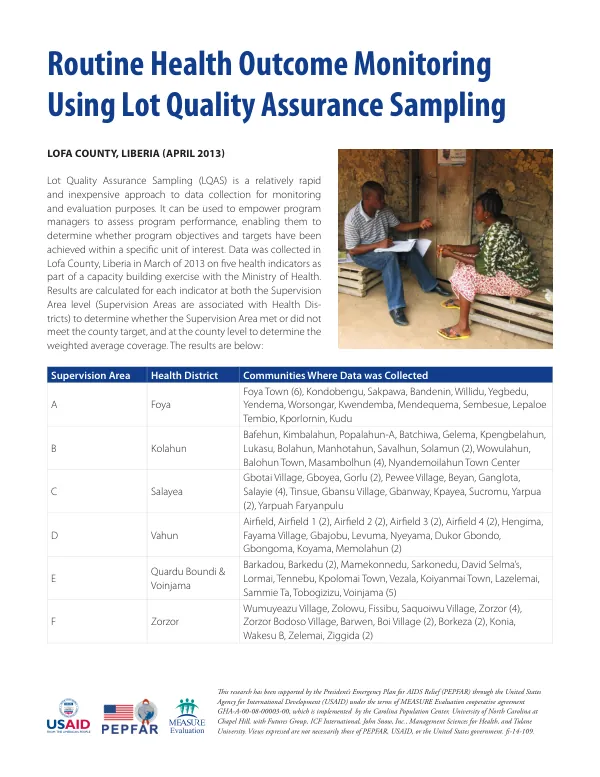
The study employed Lot Quality Assurance Sampling (LQAS), a rapid and inexpensive approach to data collection for monitoring and evaluation purposes. The primary objective was to assess program performance and determine whether program objectives and targets had been achieved within a specific unit of interest. Data was collected on five health indicators in Lofa County, Liberia, in March 2013, as part of a capacity-building exercise with the Ministry of Health. The results were calculated for each indicator at both the Supervision Area level and the county level to determine whether the Supervision Area met or did not meet the county target. The results are presented below. The study found that only half of the health districts met the target for DPT3/Penta-3 coverage, with an average coverage adjusted for population size of approximately 86% in Lofa in 2013. Despite this finding, overall Penta-3 coverage was high, with only two health districts, Vahun and Zorzor, below the average coverage. Malaria prevention coverage for the second dose of IPT during the last pregnancy was significantly lower than expected, with an overall performance of 61%. The average coverage in 2012 was 76%, and even after factoring in uncertainties around the coverage estimate, overall coverage in 2013 was less than coverage in 2012. Only the Kolahun health district met the target of 80%, while the other five health districts did not perform well in terms of meeting the set target. The 2013 results for women's dietary diversity score suggest that there was more diversity in the diet and food consumption among women in Lofa compared to previous years. All health districts in Lofa seemed to be faring better with regard to meeting the target average score of 4.4. However, if we compare individual health districts to the 2013 county average, Zorzor seemed to be falling behind the rest of the health districts, followed by Salayea and Vahun. In terms of maternal health, the attendance rate for the first ANC visit among pregnant women in Liberia tends to be higher, but thereafter drops with subsequent follow-up visits. The average coverage estimate for women attending at least 4 ANC visits during pregnancy has not been as high as it is expected, with approximately 65% of women completing at least 4 ANC visits during their last pregnancy. Based on the set target of 69%, all health districts with the exception of Vahun met this target. The proportion of births attended by a skilled birth attendant in 2013 was higher than in previous years, with two health districts, Vahun and Foya, not meeting the set target of 83% coverage. However, overall for Lofa County, the results are encouraging and suggest that campaigns and mobilization efforts by the CHSWT to ensure that births are taking place at health facilities and attended by skilled birth attendants are having some impact. Overall findings suggest that health districts are meeting the set targets for these indicators, with the exception of IPT2. However, there is indication that, compared to performance of other health districts in 2013 in Lofa, Vahun is struggling to meet the county's benchmark for several of the indicators. Attention is needed in Vahun to determine the challenges the program teams are facing there and how best the district can be assisted to meet the targets.