USAID DEC
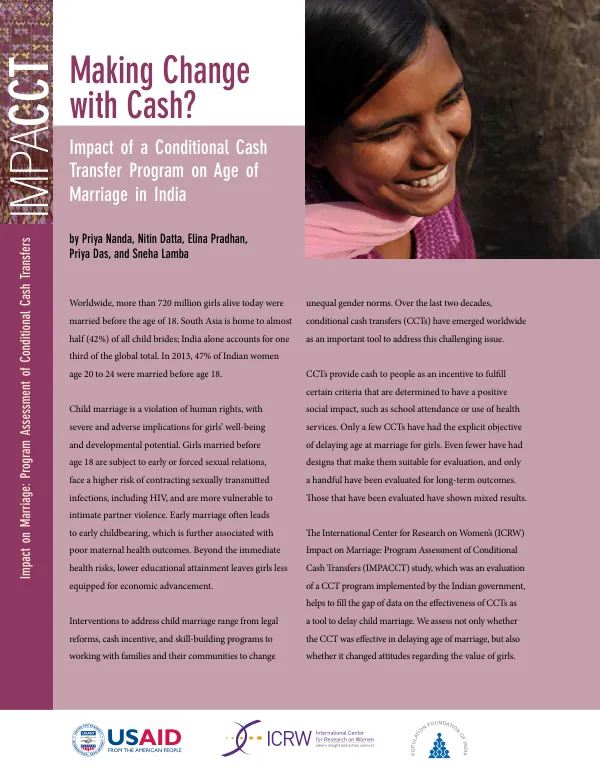
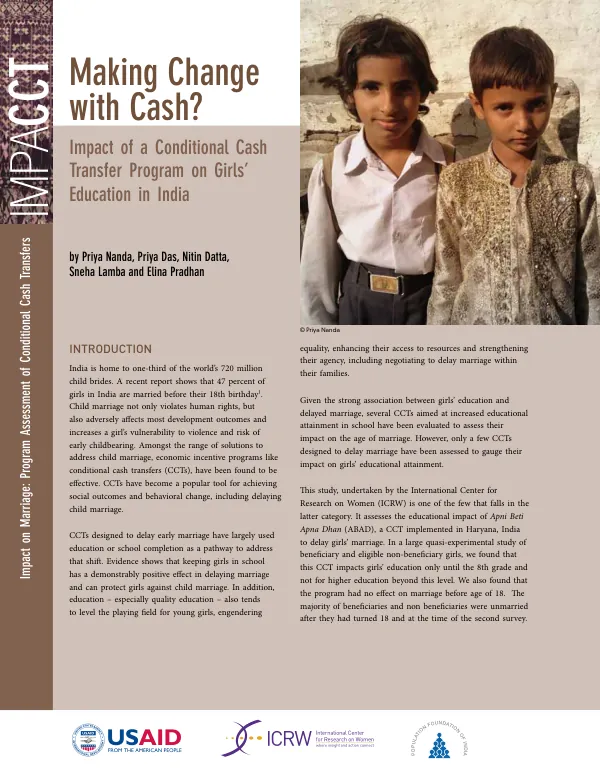
Impact of a Conditional Cash Transfer Program on Girls' Education and Age of Marriage in India
Sign inTHE INTERNATIONAL CENTER FOR RESEARCH ON WOMEN
Impact of a Conditional Cash Transfer Program on Girls' Education and Age of Marriage in India
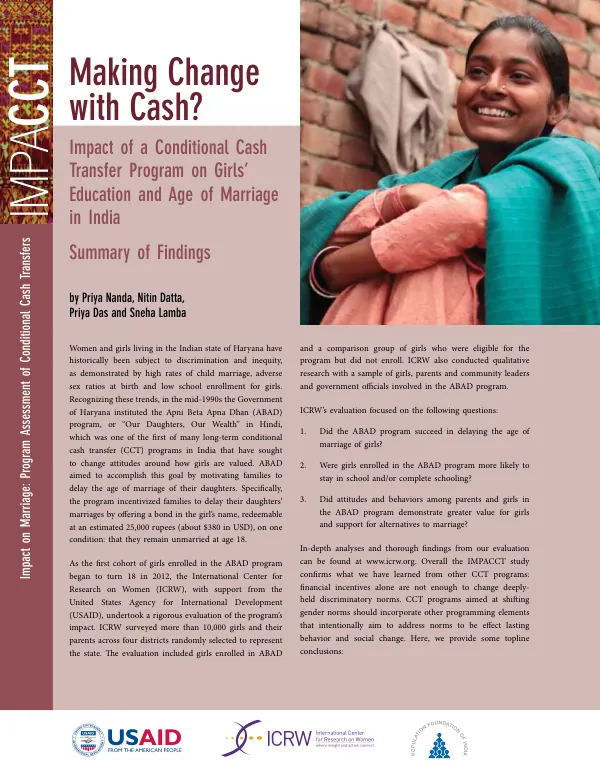
The Apni Beta Apna Dhan (ABAD) program, also known as "Our Daughters, Our Wealth," was a conditional cash transfer (CCT) program initiated by the Government of Haryana in the mid-1990s.
2016 · 2 pages
Sign in to readA free account is required to download.
Abstract
The program aimed to delay the age of marriage of girls by offering a bond in the girl's name, redeemable at an estimated 25,000 rupees (approximately $380 USD), on the condition that they remain unmarried at age 18. The program was evaluated by the International Center for Research on Women (ICRW) in collaboration with the United States Agency for International Development (USAID). The evaluation included a survey of over 10,000 girls and their parents across four districts in Haryana, as well as qualitative research with a sample of girls, parents, and community leaders involved in the ABAD program. The evaluation focused on three key questions: whether the ABAD program succeeded in delaying the age of marriage of girls, whether girls enrolled in the program were more likely to stay in school and/or complete schooling, and whether attitudes and behaviors among parents and girls in the program demonstrated greater value for girls and support for alternatives to marriage. The findings of the evaluation suggest that the ABAD program had no significant effect on whether girls married before age 18. However, girls who participated in the program were slightly more likely to have married between their 18th and 19th birthday, possibly due to the fact that the cash benefit was used by participants and their families for marriage-related expenses. The evaluation also found that girls who participated in the ABAD program were more likely to have completed 8th grade, but the program had no effect on educational attainment beyond this level. This may be due to the higher costs and low perceived value of higher education for girls in Haryana, as well as the lack of proximate educational institutions and parents' concerns for girls' safety and perceived threats of sexual violation in public spaces. The evaluation highlights several policy implications for CCT programs aimed at shifting behavioral outcomes and/or social norms. These include the need for critical design elements, such as smaller, more frequent payments that incentivize incremental behavioral changes, and a clear communications and community engagement strategy to reinforce the intent of the program. The evaluation also emphasizes the importance of transparency in CCT programs, particularly with regard to the security of funds to be paid out or changes in the cash payout. Overall, the ABAD program was a pioneering effort in using CCTs to promote girls' education and delay marriage. However, the evaluation highlights the need for more effective design and implementation strategies to achieve lasting behavioral and social change.