THE INTERNATIONAL CENTER FOR RESEARCH ON WOMEN
Impact of a Conditional Cash Transfer Program on Girls' Education in India
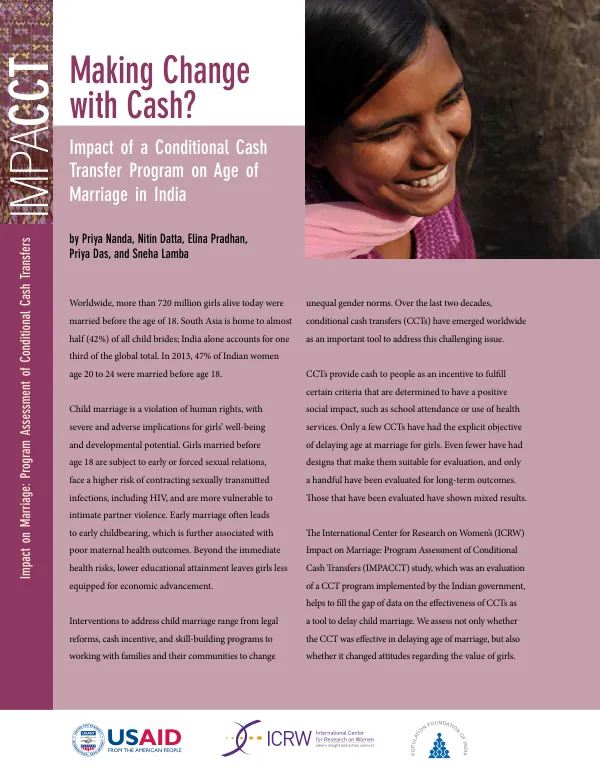
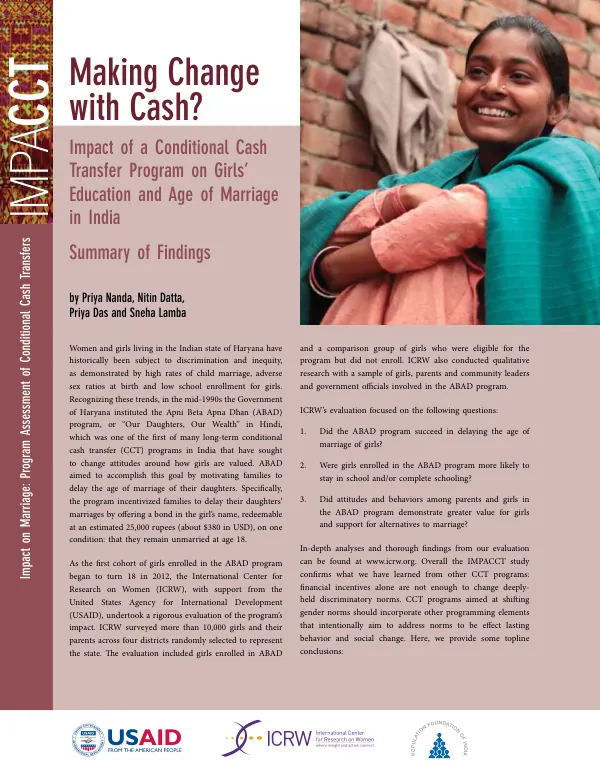
The Apni Beti Apna Dhan (ABAD) program was a conditional cash transfer (CCT) initiative implemented in Haryana, India, between 1994 and 1998.
2016 · 8 pages
Sign in to readA free account is required to download.
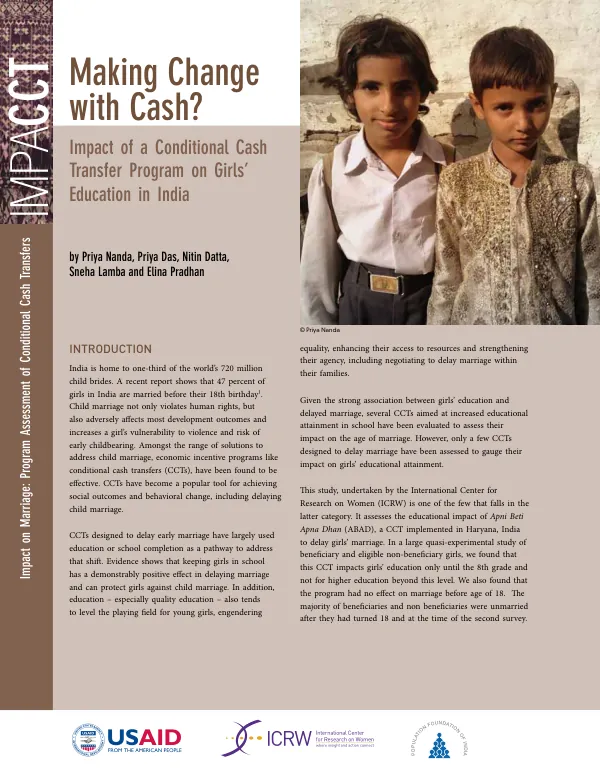
Abstract
The program aimed to enhance the value of girls and delay their marriage by providing a cash benefit to mothers upon enrollment and a savings bond redeemable at age 18, provided the girl was not married. The program was unique in that it faced a protracted period before beneficiaries could receive the cash, with disbursement explicitly conditioned on delaying marriage until at least the age of 18. The evaluation of the ABAD program was conducted by the International Center for Research on Women (ICRW) between 2010 and 2015. The study used a quasi-experimental, mixed-methods design with two time periods, one before and one after the girls turned 18. The evaluation aimed to answer three key questions: Did the ABAD program succeed in delaying marriage for girls? Were girls enrolled in the ABAD program more likely to stay in school and/or complete schooling? Do attitudes and behaviors among parents and girls in ABAD households indicate more value for girls and support for alternatives to marriage? The study found that the ABAD program had no effect on marriage before the age of 18. The majority of beneficiaries and non-beneficiaries were unmarried after they had turned 18 and at the time of the second survey. The program also had no significant impact on girls' educational attainment beyond the 8th grade. However, the study did find that girls enrolled in the ABAD program were more likely to stay in school and complete schooling up to the 8th grade compared to eligible non-beneficiaries. The study also explored the change pathways through which the CCT would enhance the value and status of girls and thereby enhance their educational attainment and delay their marriage. The researchers hypothesized that attitudes of parents would become more gender-equal, parents and girls would have intensified their aspirations for a better future, and girls would stay longer in school and thus have higher educational attainment. However, the study found that these change pathways were not significantly affected by the ABAD program. The evaluation used a multi-stage sampling design, with a sample size of 3,944 girls in the second round of the survey. The study controlled for the fact that households that participated in ABAD could be systematically different from those that did not participate. The researchers used an instrument that predicted enrollment in ABAD without directly affecting any of the two outcome variables (age of marriage and educational attainment). The instrument was based on measures of program uptake in castes other than their own, within the village. Overall, the evaluation of the ABAD program found that while the program had some positive effects on girls' education, it had no significant impact on delaying marriage or enhancing the value and status of girls. The study highlights the importance of carefully designing and implementing CCT programs to achieve their intended goals.