THE INTERNATIONAL CENTER FOR RESEARCH ON WOMEN
Impact of a Conditional Cash Transfer Program on Age of Marriage in India
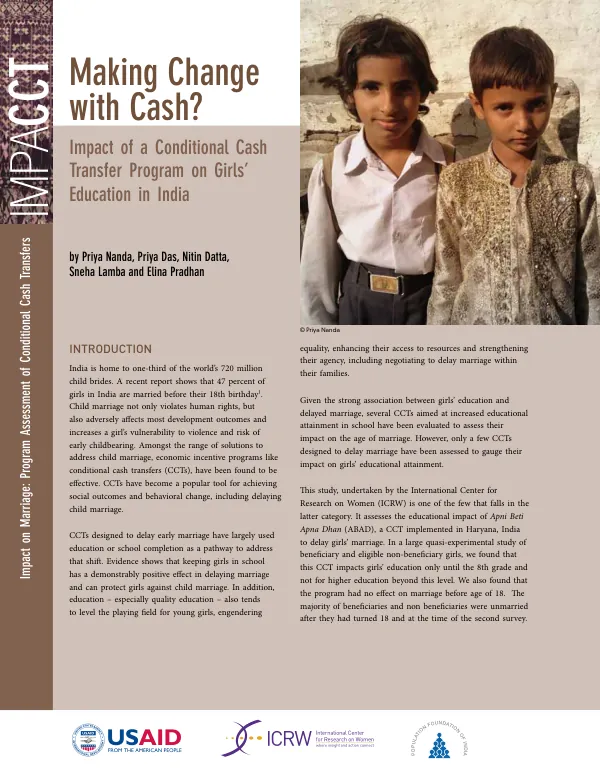
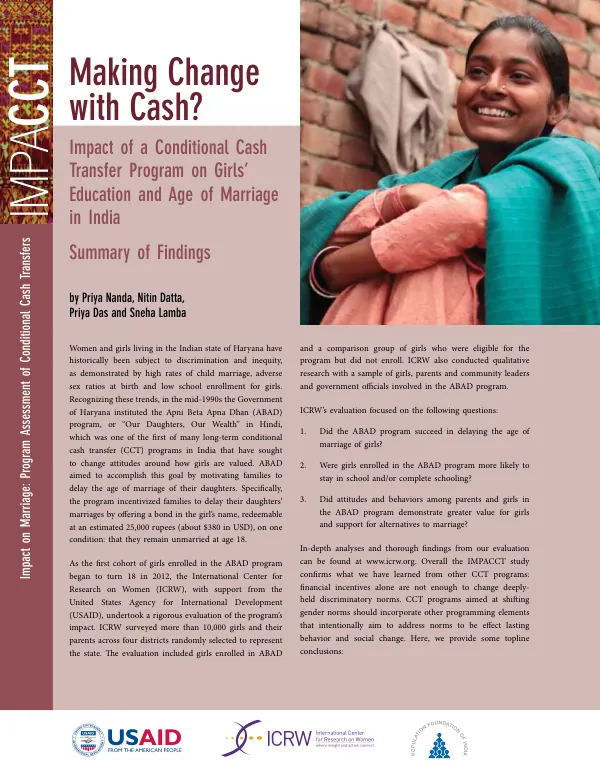
The Apni Beti Apna Dhan (ABAD) program was a conditional cash transfer (CCT) initiative implemented by the government of Haryana between 1994 and 1998.
2016 · 8 pages
Sign in to readA free account is required to download.
Abstract
The program aimed to enhance the value of girls and delay marriage by providing cash incentives to households that delayed marriage until at least age 18. Eligible households, primarily from disadvantaged subgroups and those living below the poverty line, received two points of transfer: a small cash disbursement to mothers within 15 days of delivering an eligible girl and a savings bond of 2,500 Indian Rupees purchased by the government in the name of the girl on enrollment. The program's evaluation, conducted by the International Center for Research on Women (ICRW) between 2010 and 2015, aimed to assess the impact of ABAD on both education and marriage outcomes. The evaluation used a quasi-experimental mixed-methods study design, comparing beneficiaries who enrolled in the program to eligible non-beneficiaries. Two rounds of surveys were conducted in 2012-13 and 2014-15, tracking the impact on educational attainment and marital status. The evaluation found that girls enrolled in the ABAD program were more likely to stay in school and complete schooling. The program also showed a significant impact on delaying marriage, with beneficiary girls being less likely to be married before age 18. The evaluation also found that attitudes and behaviors among parents and girls in ABAD households indicated more value for girls and support for alternatives to marriage. The study's conceptual framework identified three change pathways through which the CCT would enhance the value and status of girls: attitudes of parents becoming more gender-equal, parents and girls intensifying their aspirations for a better future, and girls staying longer in school and having higher educational attainment. The evaluation found that the program was effective in enhancing the value of girls, particularly in terms of educational attainment and delaying marriage. The study's methodology involved a multi-stage sampling design, conducting surveys in 300 primary sampling units (PSUs) within four districts in Haryana. The evaluation used bivariate probit models with instrumental variables to analyze the impact of the program on marital status and age of marriage. The study controlled for the fact that households that participated in ABAD may be systematically different from those that did not participate. The findings of the study have implications for the design and implementation of CCT programs aimed at delaying child marriage and enhancing the value of girls. The study highlights the importance of considering the context and cultural norms of the target population when designing such programs. The evaluation also underscores the need for rigorous impact evaluation to assess the effectiveness of such programs and inform policy decisions. The ABAD program's success in delaying marriage and enhancing the value of girls has been attributed to its unique design, which provided a cash incentive for households to delay marriage until at least age 18. The program's impact on educational attainment and marital status has been significant, with beneficiary girls being more likely to stay in school and complete schooling. The study's findings have implications for the design and implementation of similar programs aimed at addressing child marriage and promoting girls' education and empowerment.