UNIVERSITY OF CALIFORNIA BERKELEY
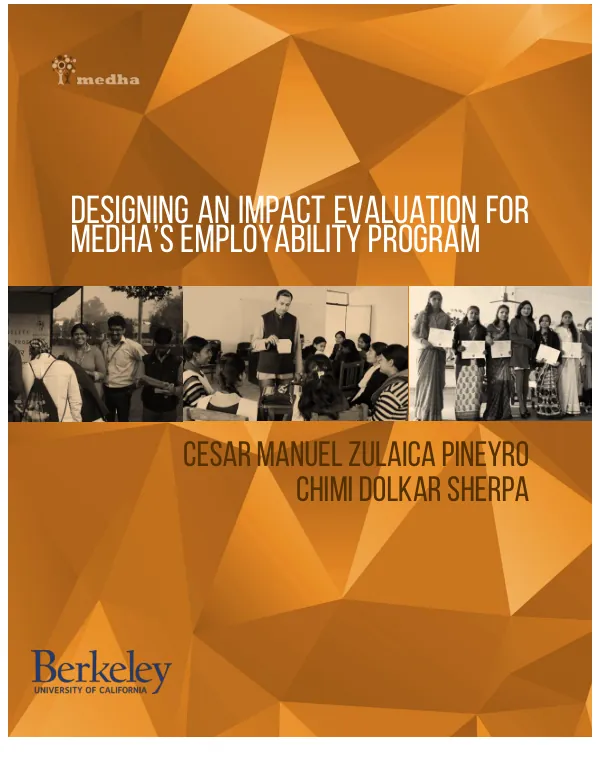
Designing an Impact Evaluation for Medha's Employability Program
Medha's Employability Program is an initiative aimed at improving employment outcomes for India's youth by providing skills and career preparation training through existing colleges and technical schools.
46 pages
Sign in to readA free account is required to download.
Abstract
The program focuses on two main interventions: the Career Advancement Bootcamp (CAB) and the Technical Advancement Bootcamp (TAB). CAB primarily focuses on career preparation, leadership skills, and industry exposure, while TAB expands on CAB by providing students with technical knowledge such as computer skills, including Microsoft Office and Email. The program targets students who are in need of skills and career preparation training to increase their prospects of securing employment. Medha's efforts are currently focused on two programs, with a Career Advancement Bootcamp (CAB) being the primary focus. CAB provides students with career preparation, leadership skills, and industry exposure, while TAB provides students with technical knowledge such as computer skills. The impact evaluation aims to measure the effect of CAB on employability, income, and life skills for students who received the treatment. A randomized assignment is used as the identification strategy, as the eligible population is far greater than the number of spaces that Medha can offer in the treatment group. Randomization also gives the best estimate of the counterfactual, which in this case would be the employment, income, and psychosocial outcomes of the treatment group had they not received the treatment of CAB. The study design involves randomization at the individual level, as opposed to the school level, to better control for confounding variables. This is possible because many schools have oversubscription for Medha's bootcamps, allowing for randomization at the individual level. The study aims to estimate the impact of CAB on employability, income, and life skills, and to identify the factors that contribute to the effectiveness of the program. The study will use a variety of indicators to measure the impact of CAB, including employment rates, income levels, and psychosocial outcomes. The study will also examine the factors that contribute to the effectiveness of the program, including the quality of the training, the level of engagement among participants, and the availability of job opportunities. The study will be conducted over a period of time, with regular follow-up with treatment and control groups to collect data on the outcomes of interest. The study will also involve the use of a randomization tool to ensure that the treatment and control groups are comparable in terms of their characteristics. The study has several limitations, including the potential for attrition, spillover effects, low enrollment, and differences in the quality of treatment. However, these limitations will be addressed through the use of a robust study design and data collection methods. The study will provide valuable insights into the effectiveness of Medha's Employability Program and will inform the development of similar programs in the future. The study will also contribute to the existing literature on the impact of vocational training programs on employment outcomes and will inform policy decisions related to youth employment in India.