USAID DEC
Impact of mhealth messages and environmental cues on hand hygiene practice among healthcare workers in the greater Kampala metropolitan area, Uganda: study protocol for a cluster randomized trial
Sign inMINISTRY OF HEALTH
Impact of mhealth messages and environmental cues on hand hygiene practice among healthcare workers in the greater Kampala metropolitan area, Uganda: study protocol for a cluster randomized trial
The study aims to determine the impact of mobile phone WASH text messages and environmental cues on hand hygiene practice among healthcare workers (HCWs) in the Greater Kampala Metropolitan Area (GKMA).
2021 · 12 pages
Sign in to readA free account is required to download.
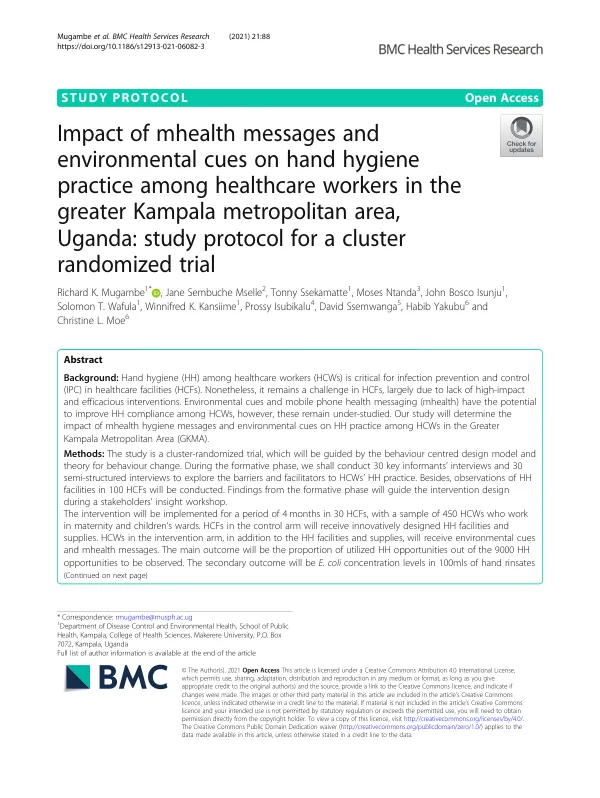
Abstract
The study will be conducted in 30 healthcare facilities (HCFs) in the GKMA, which includes Kampala, Wakiso, and Mukono districts. The study setting is characterized by high urbanization rates, poverty, and limited access to services. The study will employ a cluster-randomized trial design, guided by the behaviour centred design model and theory for behaviour change. The study will involve 450 HCWs who work in maternity and children's wards. The intervention will be implemented for a period of 4 months, with the control arm receiving innovatively designed hand hygiene facilities and supplies, while the intervention arm will receive environmental cues and mhealth messages in addition to the facilities and supplies. The main outcome of the study will be the proportion of utilized hand hygiene opportunities out of 9000 hand hygiene opportunities to be observed. The secondary outcome will be E. coli concentration levels in 100mls of hand rinsates from HCWs, an indicator of recent fecal contamination and hand hygiene failure. The study will use multivariable logistic regression under the generalized estimating equations (GEE) framework to account for the dependence of hand hygiene on the intervention. The study will provide critical findings on barriers and facilitators to hand hygiene practice among HCWs, and the impact of environmental cues and mhealth messages on HCWs' hand hygiene practice. The study will also explore the facilitators and barriers to hand hygiene among HCWs in HCFs in the GKMA. The study's objectives are to determine the impact of mhealth messages and environmental cues on hand hygiene practices among HCWs in HCFs in the GKMA, to explore the facilitators of hand hygiene among HCWs, and to explore the barriers to hand hygiene among HCWs. The study's methodology involves conducting 30 key informants' interviews and 30 semi-structured interviews to explore the barriers and facilitators to HCWs' hand hygiene practice. Observations of hand hygiene facilities in 100 HCFs will also be conducted. Findings from the formative phase will guide the intervention design during a stakeholders' insight workshop. The study will be conducted in partnership with the Ministry of Health (MOH), Ministry of Water and Environment (MWE), WaterAid Uganda, and Kampala Capital City Authority (KCCA). The study's significance lies in its potential to provide critical findings on barriers and facilitators to hand hygiene practice among HCWs, and the impact of environmental cues and mhealth messages on HCWs' hand hygiene practice. The study's findings will inform the development of effective interventions to improve hand hygiene compliance among HCWs in the GKMA. The study's results will also contribute to the existing body of knowledge on hand hygiene practices among HCWs in low- and middle-income settings.