CATHOLIC RELIEF SERVICES ORGANIZATION
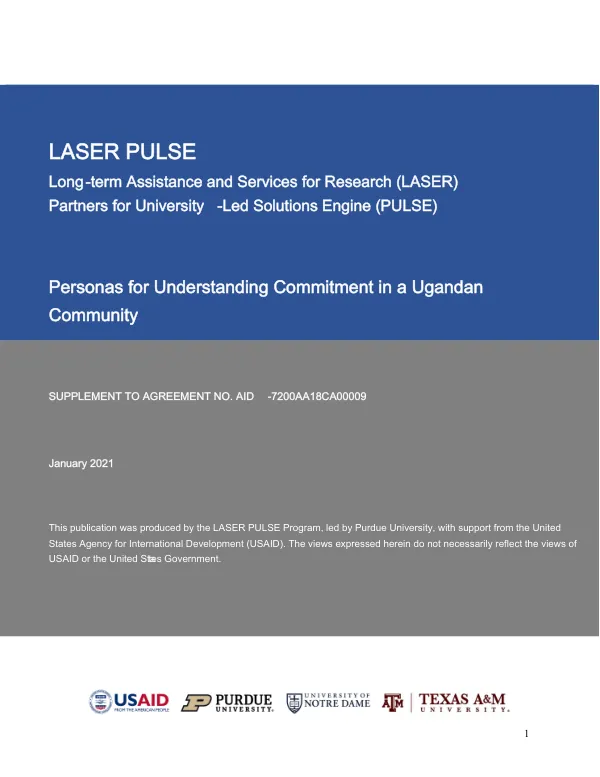
Personas for Understanding Commitment in a Ugandan Community
The LASER PULSE Program, led by Purdue University, is a five-year, $70M initiative funded through USAID's Innovation, Technology, and Research Hub.
2021 · 7 pages
Sign in to readA free account is required to download.
Abstract
The program delivers research-driven solutions to field-sourced development challenges in USAID interest countries. A consortium led by Purdue University, with core partners Indiana University, the University of Notre Dame, Makerere University, and Catholic Relief Services, implements the LASER PULSE program through a growing network of 2,300+ researchers and development practitioners in 56 countries. The program collaborates with USAID missions, bureaus, and independent offices and other local stakeholders to identify research needs for critical development challenges. LASER PULSE funds and strengthens the capacity of researcher-practitioner teams to co-design solutions that translate into policy and practice. The program's focus is on addressing complex development challenges, including those related to health, education, and economic development. In the context of a Ugandan community, the LASER PULSE Program has identified four personas that reflect the aggregate data analysis and help understand respondents' indigenous experiences and approaches regarding commitment. These personas are based on the research conducted and the data collected from different people (leaders and participants) in a local Ugandan community. The first persona is Community Leader Lindia, a female local community leader who is well-educated, married with four kids, and a credible individual in the community. Lindia understands the local norms and traditions and is emotionally intelligent, which enables her to create awareness within the community. She takes personal responsibility towards women's health issues and empowers parents, women, and young adults by involving them in community-based activities. Lindia believes in the effectiveness of group/committee work and supports giving and receiving feedback to teachers and doctors/health providers. She implements mechanisms to provide implementing rules and bylaws, building individuals' capacity in the local community, and effectively communicating and engaging individuals about the benefits and challenges of programs. Lindia also supports building community support for women's health and health insurance, participatory planning with community engagement to solve more urgent issues, and systematically assessing learning and using evidence to set priorities and inform policies. The second persona is Program Participant Pasua, a female local community participant who understands the importance of awareness and awareness creation among families to help improve the health and educational status of family members and individuals in the community. Pasua actively supports and sometimes participates in capacity building trainings and learning activities, such as parent education programs and preventing pregnancy complications awareness programs. She participates in community activities, such as volunteering to provide health-related support to young females and/or involvement in school governance. Pasua encourages kids' education, has relative power in family relations and decision making, and worries about the health of her family and community, especially after the spread of COVID-19. She is suspicious towards donors and non-local NGOs working on gender-based issues due to past experiences with politically driven agendas or due to promises not fulfilled. Pasua believes in having a support structure within the family and/or minimal barriers to education and health services, being able to trust the system because funding/decisions are transparent, and having self-motivation for change. The third persona is Community Leader Mukasa, a male local community leader who is a chief administrator of the gods. Mukasa believes in the importance of community development and change, and he supports the empowerment of locals, self-confidence, and financial literacy. He encourages kids' education and has relative power in family relations and decision making. Mukasa worries about the health of his family and community, especially after the spread of COVID-19, and believes in having a support structure within the family and/or minimal barriers to education and health services. The four personas reflect the diverse perspectives and experiences of individuals in a Ugandan community regarding commitment. They highlight the importance of community development, education, health, and economic empowerment in addressing complex development challenges. The LASER PULSE Program's focus on co-designing solutions with researcher-practitioner teams and local stakeholders is critical in addressing these challenges and promoting sustainable development outcomes.