USAID DEC
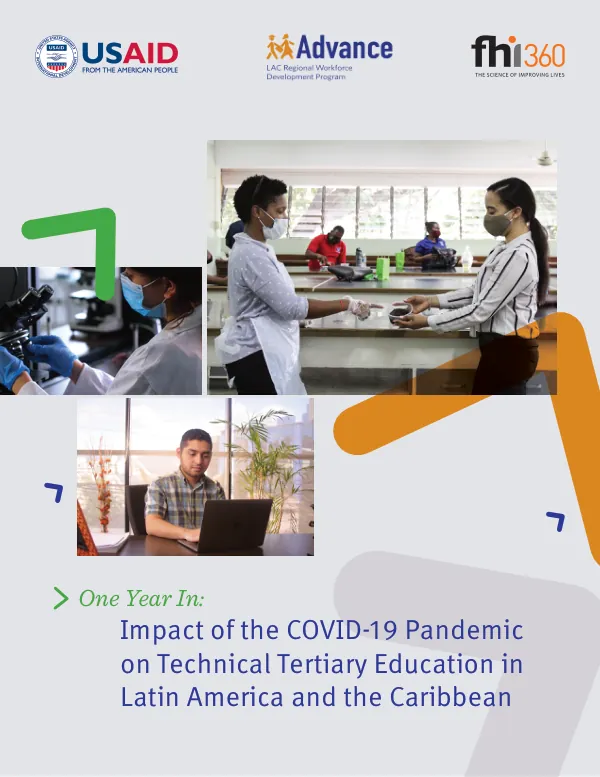
Impact of the COVID-19 Pandemic on Technical Tertiary Education in Latin America and the Caribbean: One Year In
Sign inFHI 360
Impact of the COVID-19 Pandemic on Technical Tertiary Education in Latin America and the Caribbean: One Year In
Technical tertiary education in Latin America and the Caribbean has been significantly impacted by the COVID-19 pandemic.
2021 · 14 pages
Sign in to readA free account is required to download.
Abstract
Across the region, higher education institutions have largely suspended face-to-face instruction due to the pandemic, with some institutions ceasing instruction entirely for varying amounts of time. However, a year into the pandemic, some institutions have commenced in-person teaching, more commonly in laboratories and other hands-on practical instruction. Prior to the pandemic, little higher education was being conducted online in the region, and most tertiary teachers and students had little or no experience teaching and learning virtually. Despite increasing internet use, spurred by mobile access, the region still faces significant challenges in terms of internet access. As of 2018, just 34 percent of households in Central America and 20 percent of households in the Caribbean had internet access. Furthermore, broadband (4G) mobile access is low in the region and practically nonexistent in the Caribbean. Students in technical tertiary education programs in LAC are more likely to come from disadvantaged backgrounds and less likely to have access to reliable internet access, data plans, and equipment necessary to successfully participate in virtual learning. The Advance Program, funded by USAID, is strengthening the capacity of select two- and three-year technical tertiary education programs to provide market-relevant, quality training to disadvantaged youth in the Dominican Republic, Guatemala, Honduras, and Jamaica. A desk review and analysis of program documents, as well as surveys and stakeholder consultations, were conducted to assess the impact of the pandemic on technical tertiary education programs in the region. The consultation process included representatives from 11 universities, community colleges, and technical institutes across the region, as well as four key higher education institutions in El Salvador offering technical tertiary education programs. The document organizes the impact of COVID-19 on technical tertiary education in the region into six different themes: access, enrollment, retention, and completion; adaptation of content and delivery to virtual modalities; quality of learning; labor market interventions; finances; and competition and collaboration. The document highlights the importance of investment in technical education as a way to access higher education and employment opportunities for disadvantaged populations, particularly women in traditionally male-dominated technical fields. Institutional representatives are hopeful about the possibilities for expansion of technical tertiary education, and the document serves as a starting point for discussion on which steps might be prioritized to continue building institutional capacity to connect technical tertiary education students to better opportunities in their home countries, through the pandemic and beyond.
Related documents