USAID DEC
Implementation Plan & Project Timeline for Commercialization of Innovative Technology
Sign inUSAID DEC
Implementation Plan & Project Timeline for Commercialization of Innovative Technology
The project aims to bring innovative technology to the point of commercialization and validation in the marketplace.
2015 · 3 pages
Sign in to readA free account is required to download.
Abstract
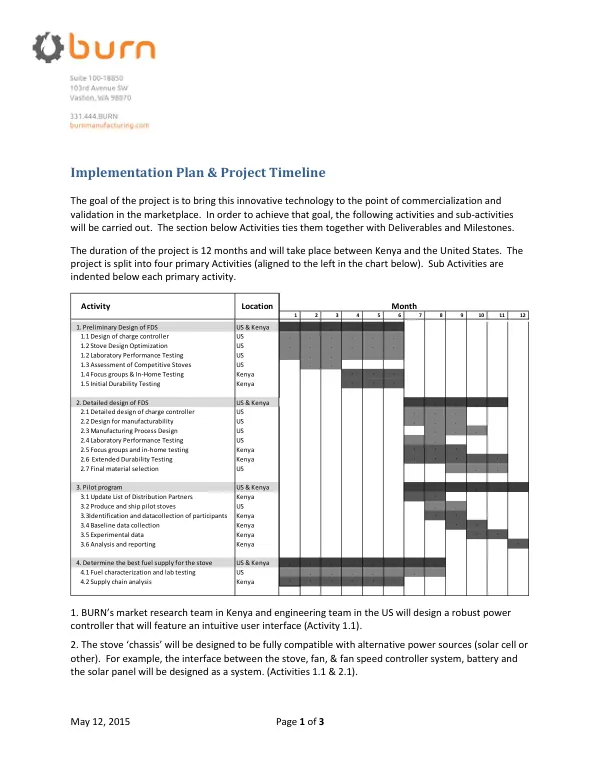
The project duration is 12 months and will take place between Kenya and the United States. The project is split into four primary activities: Preliminary Design, Detailed Design, Pilot Program, and Determine the Best Fuel Supply for the Stove. Preliminary Design involves designing a robust power controller with an intuitive user interface, as well as designing the stove 'chassis' to be fully compatible with alternative power sources. Initial user research will be conducted by the in-house market research team in Kenya to optimize the stove for the Kenyan context. Performance and CO and PM2.5 emission testing will be conducted at BURN's lab in Washington State. Detailed Design involves detailed design of the fuel delivery system, design for manufacturability, manufacturing process design, and laboratory performance testing. Focus groups and in-home testing will be conducted in Kenya, and extended durability testing will be conducted to assess the stove's performance and durability. Final material selection will be made based on the results of the testing. The Pilot Program involves updating the list of distribution partners, producing and shipping pilot stoves, identifying and collecting data from participants, baseline data collection, experimental data collection, and analysis and reporting. Field emission testing will be conducted by Berkeley Air Monitoring Group, and kitchen performance tests will be conducted by BURN's M&E team in Kenya. The project will also involve determining the best fuel supply for the stove, including fuel characterization and lab testing, supply chain analysis, and lab results of fuels rated highly in supply chain analysis. The project will track development progress and stove performance using key activities/results and metrics, including improved cookstove metrics such as high power efficiency, low power specific consumption, high power PM2.5, and low power CO. The project will result in the development of a commercialized and validated stove, with a robust power controller and a fully compatible stove 'chassis'. The stove will be optimized for the Kenyan context, and its performance and durability will be tested and validated through laboratory and field testing. The project will also identify the best fuel supply for the stove, including alternative pelletized fuels, chipped wood, and sticks.
Related documents