USAID DEC
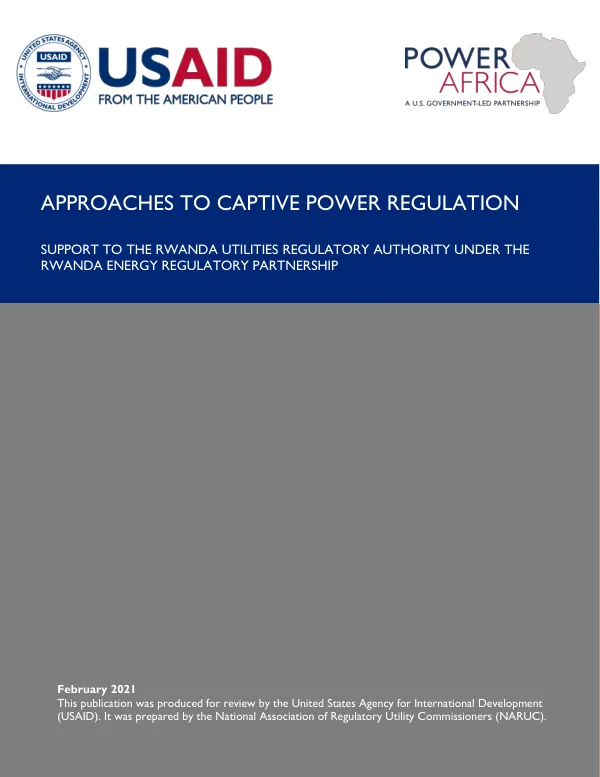
Approaches to Captive Power Regulation: Support to the Rwanda Utilities Regulatory Authority under the Rwanda Energy Regulatory Partnership
Sign inU.S. NATIONAL ASSOCIATION OF REGULATORY UTILITY COMMISSIONERS
Approaches to Captive Power Regulation: Support to the Rwanda Utilities Regulatory Authority under the Rwanda Energy Regulatory Partnership
Captive Power Regulation in Rwanda is a critical aspect of the country's energy sector, particularly with the increasing adoption of renewable energy sources.
2021 · 28 pages
Sign in to readA free account is required to download.
Abstract
The Rwanda Utilities Regulatory Authority (RURA) is seeking to establish a regulatory framework for customers generating and consuming electricity on-site by deploying captive power infrastructure. The concept of captive power refers to behind-the-meter electricity generation used explicitly or mainly for self-consumption. Historically, captive power suppliers have been large industries where quality and continuity of supply are of utmost importance. However, with the decreasing cost of solar power systems, there is a shift towards smaller solar power systems in the form of Distributed Energy Resources (DERs). Rwanda expects a widespread application of solar DERs into the system, which will pose implementation challenges for technical and regulatory reasons. A robust national regulatory framework is necessary to govern operations and minimize implementation and operational challenges. The decentralized supply chain made up of various DER systems at the distribution level may be perceived as a threat to distribution companies' financial viability and status-quo network operations. Regulators must assess these foreseeable challenges and address them in a comprehensive regulatory framework designed to address common implementation and operational challenges as exhibited in other countries that have already deployed considerable volumes of DER and captive power technologies. Gleaning lessons learned from their experiences will inform RURA's approach, which will contribute to a well-formulated regulatory framework for growing DER infrastructure. The report emphasizes the need for Rwanda to start developing an adoption plan for DERs in order to capture their long-term benefits early on and provide value for all customers. This report proposes that RURA develop a longer vision on captive power and prepare a strategy for DER implementation that both encompasses captive power and embraces various advantageous DER technologies to ensure greater power system efficacy. The report compares and contrasts respective captive power regulations in place in the U.S., Uganda, Nigeria, Kenya, and Turkey. These case studies provide examples of how RURA can prepare a regulatory framework to appropriately serve Rwanda's immediate need to regulate captive power, addressing foreseeable pitfalls and challenges by ensuring relevant regulatory provisions beforehand. The U.S. case study provides an overview of how rooftop solar panels led to net metering regulations in the U.S., and how these developments evolved into initiatives to integrate more DER into the grid, and prompted regulators and government agencies to prepare for the future of heterogeneous and evolving electricity grids. The regulatory framework for captive power and DERs should address common implementation and operational challenges, such as ensuring the quality and continuity of supply, managing the decentralized supply chain, and addressing potential risks and opportunities. The framework should also provide a clear and transparent regulatory environment for private sector investment in captive power and DER generation sources. In conclusion, the regulation of captive power and DERs is a critical aspect of Rwanda's energy sector, and a well-formulated regulatory framework is necessary to ensure the successful adoption and implementation of these technologies. The report provides a comprehensive overview of the regulatory challenges and opportunities associated with captive power and DERs, and proposes a regulatory framework that addresses these challenges and provides a clear and transparent regulatory environment for private sector investment.