TETRA TECH
Implementation & Procurement Reform: Achievements
Implementation and Procurement Reform is a key area of reform within the USAID FORWARD comprehensive package of reforms.
2011 · 9 pages
Sign in to readA free account is required to download.
Abstract
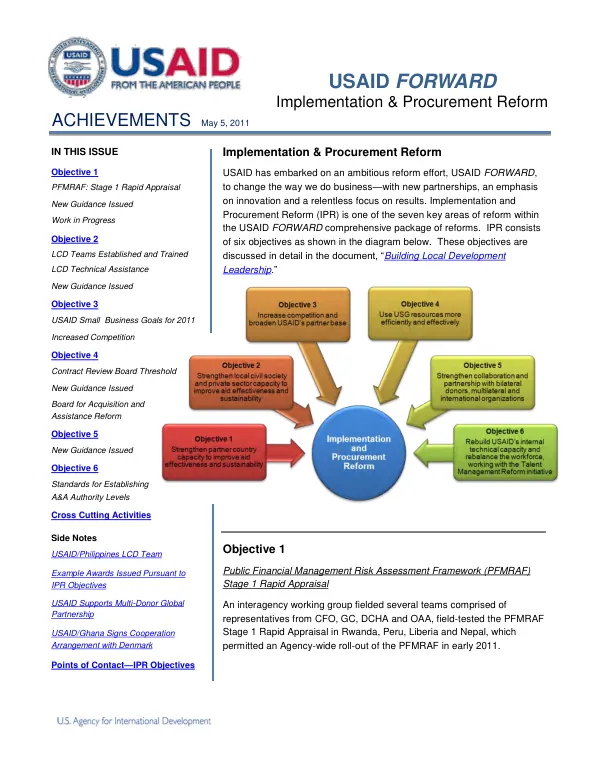
The reform effort aims to change the way USAID does business, with a focus on new partnerships, innovation, and results. Implementation and Procurement Reform consists of six objectives, which are discussed in detail in the document "Building Local Development Leadership." The first objective, Public Financial Management Risk Assessment Framework (PFMRAF), involves a rapid appraisal of country-level fiduciary risks related to Public Financial Management. The PFMRAF was field-tested in Rwanda, Peru, Liberia, and Nepal, and the results were used to roll out the framework Agency-wide in early 2011. New guidance was issued for the use of partner country systems, and a series of four training courses related to partner country systems are currently being developed for delivery this summer. The second objective, Local Capacity Development Teams Established and Trained, involves the establishment of five Local Capacity Development (LCD) Teams in Peru, Egypt, South Africa, Kenya, and the Philippines. The teams were trained in LCD action planning, and a one-week local capacity development training/workshop was held in Dakar, Senegal, for participants from USAID missions in Mali, Sierra Leone, Guinea, Ghana, Liberia, and Mozambique. The workshop included sessions on aid effectiveness, sector mapping, organizational assessment, and development approaches. Local Capacity Development Technical Assistance has been provided to various missions and global offices and bureaus, including the Development Grants Program, USAID/Egypt, EGAT's Human and Institutional Capacity Development program, and USAID/Philippines. The Agency has also issued revised policy guidance on the use of fixed obligation grants (FOGs), which allow grants with first-time and higher-risk recipients that have demonstrated technical capabilities. The third objective, USAID Small Business Goals for 2011, involves increasing competition and opportunities for small businesses. The Agency recently released the USAID Small Business Goals for 2011, which aim to increase the participation of small businesses in USAID's procurement process. The goals include increasing the number of small business awards, increasing the value of small business awards, and increasing the number of small businesses that participate in USAID's procurement process. The fourth objective, Contract Review Board Threshold, involves increasing the threshold for contract review board approval. New guidance was issued for the use of fixed obligation grants, which allows for advance payments under specific conditions and makes payments based on the completion of defined outputs or milestones. The Agency has also issued a blanket waiver of source/origin/nationality requirements for procurement of goods and services up to $5 million per award. The fifth objective, Delegation of Authority Standards for Establishing Acquisition and Assistance Authority Levels, involves increasing the warrant authority that Mission Directors may receive for issuing awards to indigenous organizations. The expanded warrant has been increased to $6.5 million to sign assistance awards with non-U.S. NGOs, and is limited to use in the country of assignment and for assistance awards only. The sixth objective, Delegation of Authority to Write-Off Bad Debt Increased, involves increasing the delegation of authority to Mission Directors to write-off certain bad debts from $5,000 to $25,000. The CFO has increased the delegation of authority to Mission Directors to write-off certain bad debts from $5,000 to $25,000.