USAID DEC
Implementing an Occupational Health and Safety Management System
Occupational Health and Safety Management Systems (OHSMS) are critical components of modern workplaces, ensuring the well-being of employees and minimizing risks associated with accidents and injuries.
214 pages
Sign in to readA free account is required to download.
Abstract
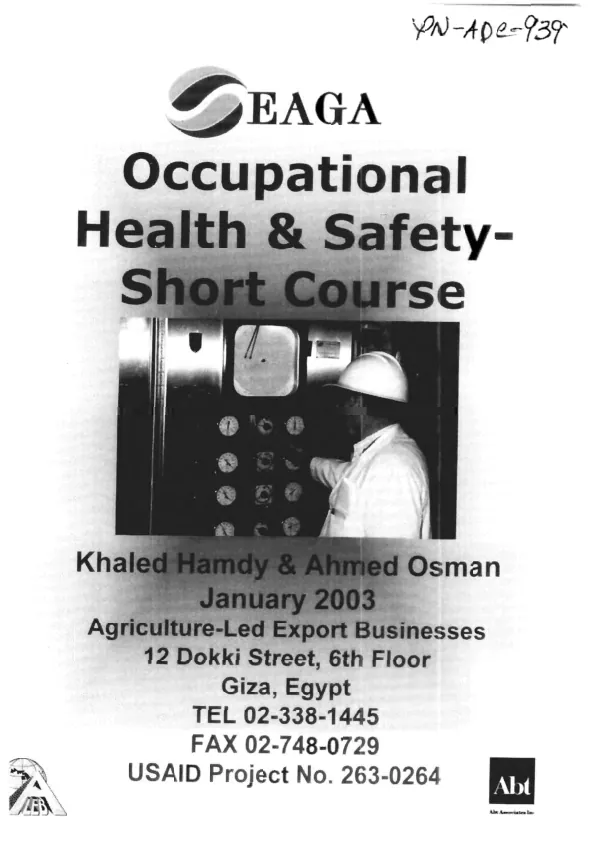
The implementation of an OHSMS is a complex process that requires careful planning, execution, and ongoing evaluation. The primary objective of an OHSMS is to provide a framework for identifying, assessing, and controlling hazards in the workplace. This involves developing and implementing policies, procedures, and practices that minimize the risk of accidents and injuries. A well-designed OHSMS also helps organizations to comply with relevant laws, regulations, and industry standards, such as OHSAS 18001. Dr. Khaled Hamdy and Eng. Ahmed Osman, the trainers for this course, bring extensive experience and expertise in the field of occupational health and safety. Dr. Hamdy has 18 years of international experience in engineering, quality, and safety, and is a registered Lead Auditor and Professional Engineer. Eng. Osman holds a Bachelor of Engineering degree and is an occupational health and safety manager in a multinational company. The course notes outline the key concepts and terminology associated with OHSMS, including safety definitions, risk management, and hazard identification. The functional vocabulary section provides a comprehensive list of terms and definitions, including safety, accident, incident, loss, risk, and hazard. The course also covers the development of safety management systems, including the identification of hazards, risk evaluation, and the implementation of control measures. The trainers' profiles highlight their expertise and qualifications in the field of occupational health and safety. Dr. Hamdy's experience in business process analysis, total quality management, and risk management is particularly relevant to the development and implementation of OHSMS. Eng. Osman's experience as an occupational health and safety manager in a multinational company provides valuable insights into the practical application of OHSMS in real-world settings. The course notes also provide a comprehensive overview of the OHSMS framework, including the identification of hazards, risk evaluation, and the implementation of control measures. The section on risk management highlights the importance of identifying and assessing risks, and implementing control measures to minimize the likelihood and impact of accidents and injuries. Overall, the course notes provide a comprehensive and detailed overview of the key concepts and terminology associated with OHSMS. The trainers' expertise and qualifications ensure that delegates receive high-quality training and guidance on the development and implementation of OHSMS.