USAID DEC
Implementing and scaling-up Stepping Stones in KwaZulu-Natal, South Africa: lessons from working in informal settlements
Sign inPOPULATION COUNCIL
Implementing and scaling-up Stepping Stones in KwaZulu-Natal, South Africa: lessons from working in informal settlements
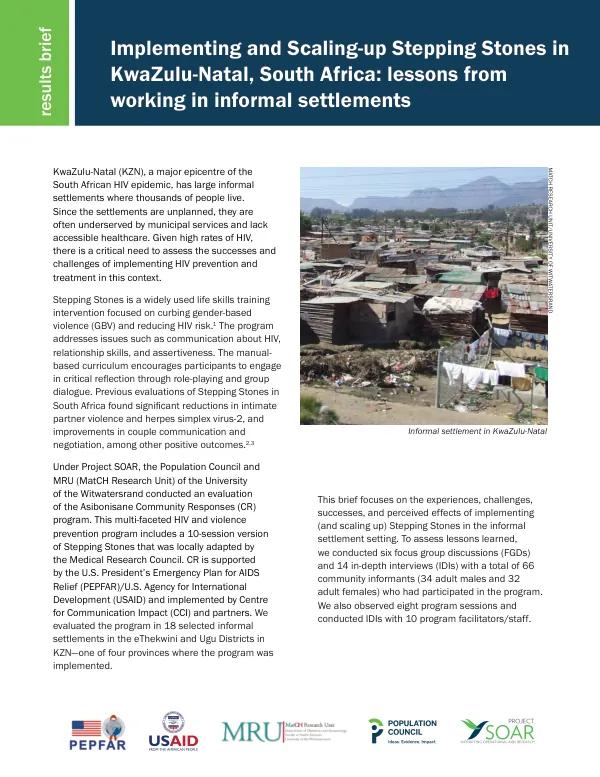
The Stepping Stones life skills training intervention was implemented in 18 informal settlements in the eThekwini and Ugu Districts of KwaZulu-Natal, South Africa, as part of the Asibonisane Community Responses (CR) program.
2021 · 4 pages
Sign in to readA free account is required to download.
Abstract
The program aimed to curb gender-based violence and reduce HIV risk through a 10-session version of Stepping Stones, which was locally adapted by the Medical Research Council. The CR program was supported by the U.S. President's Emergency Plan for AIDS Relief (PEPFAR)/U.S. Agency for International Development (USAID) and implemented by Centre for Communication Impact (CCI) and partners. Community members who participated in the Stepping Stones program reported a safe and supportive learning environment, where they gained knowledge and understanding about HIV and AIDS, as well as gender-related issues. Many participants, particularly females, described the sessions on gender-based violence as having the most appeal, and reported that they learned how to protect themselves and access help. Participants also reported improved communication with their partners, with many males describing how learning to communicate had facilitated personal behavior change, including reducing violent behavior towards their female partners. Observations and interviews with staff and participants highlighted the challenges of implementing the program in informal settlements, including finding an appropriate venue, managing large group sizes, and dealing with structural challenges such as limited time and competing priorities. However, well-prepared facilitators were key to ensuring well-run and cohesive groups, and mixed-sex groups were found to work well in facilitating discussions about sensitive issues. Community members suggested adding content on substance abuse and child abuse, with some female participants noting that child abuse and rape are common in their communities and expressing a desire to learn more about how to deal with this. Some men would have liked more information on how to deal with substance abuse, including referrals for assistance. The CR program was well received by community members, and the Stepping Stones intervention was found to be effective in reducing HIV risk and promoting behavior change. However, the program faced challenges in implementation, including managing group sizes and dealing with structural challenges. The findings of this evaluation highlight the importance of well-prepared facilitators and the need for additional content on substance abuse and child abuse. The evaluation of the CR program was conducted through six focus group discussions and 14 in-depth interviews with community informants, as well as observations of eight program sessions and interviews with 10 program facilitators/staff. The evaluation aimed to assess the successes and challenges of implementing the Stepping Stones program in informal settlements, and to identify lessons learned that can inform future programming. The Stepping Stones program was found to be effective in promoting behavior change and reducing HIV risk, particularly among female participants. The program's focus on communication, relationship skills, and assertiveness was seen as beneficial, and participants reported improved communication with their partners and reduced violent behavior. However, the program faced challenges in implementation, including managing group sizes and dealing with structural challenges. The evaluation highlights the importance of well-prepared facilitators and the need for additional content on substance abuse and child abuse. The findings of this evaluation can inform future programming and policy decisions aimed at reducing HIV risk and promoting behavior change in informal settlements.
Related documents
Documents in this collection
 2013
2013USAID DEC
Spatial distribution and role of neighborhood characteristics in co-morbidity of HIV and chronic non-communicable disease in an informal township in South Africa
Open record 2009
2009USAID DEC