USAID DEC
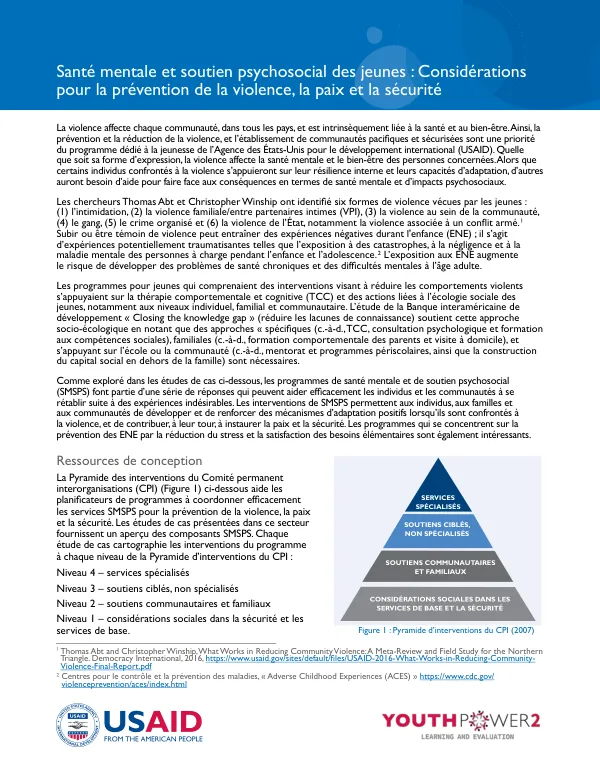
Youth Mental Health and Psychosocial Support: Considerations for Violence Prevention, Peace, and Security
Sign inINTER-AMERICAN DEVELOPMENT BANK
Youth Mental Health and Psychosocial Support: Considerations for Violence Prevention, Peace, and Security
Violence affects every community, in every country, and is deeply connected to health and well-being.
2021 · 8 pages
Sign in to readA free account is required to download.
Abstract
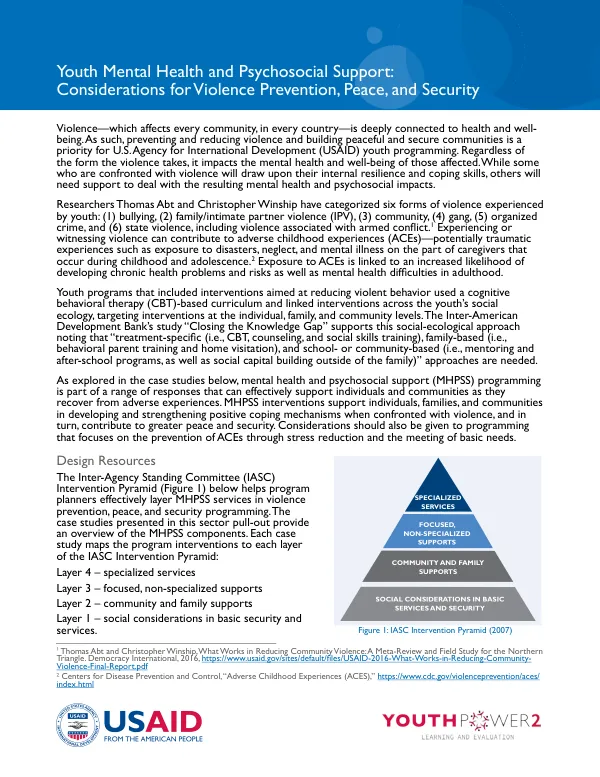
Preventing and reducing violence and building peaceful and secure communities is a priority for the U.S. Agency for International Development (USAID) youth program. Regardless of the form the violence takes, it impacts the mental health and well-being of those affected. While some individuals may draw upon their internal coping skills, others may need support to deal with the resulting mental health and psychosocial impacts. Thomas Abt and Christopher Winship have categorized six forms of violence experienced by youth: bullying, family/intimate Partner Violence (IPV), community violence, gang violence, organized crime, and state violence. Experiencing or witnessing violence can lead to adverse childhood experiences (ACEs), potentially traumatic events such as exposure to disasters, neglect, and neglect on the part of parents. Exposure to ACEs is linked to an increased likelihood of developing chronic health problems and mental health difficulties in adulthood. Youth programs that included interventions aimed at reducing violent behavior used a cognitive behavioral therapy (CBT)-based curriculum and linked interventions across the youth's social ecology, targeting individual, family, and community levels. The Inter-American Development Bank's study, "Closing the Knowledge Gap," notes that treatment-specific (CBT, counseling, and social skills training), family-based (behavioral parent training and home visitation), and school/community-based (mentoring and after-school programs, as well as social skills building outside of the family) approaches are needed. Mental health and psychosocial support (MHPSS) programming is part of a range of responses that can support individuals and communities as they recover from adverse experiences. MHPSS interventions support individuals, families, and communities in developing and strengthening positive coping mechanisms when confronted with violence, and in turn, contribute to greater peace and security. Considerations should also be given to programming that focuses on preventing ACEs through stress reduction and meeting basic needs. The Inter-Agency Standing Committee (IASC) Intervention Pyramid helps program planners effectively layer MHPSS services in violence prevention, peace, and security. The pyramid consists of four layers: specialized services, focused non-specialized supports, community and family supports, and social considerations in basic security and services. Each layer is essential in providing comprehensive support to individuals and communities affected by violence. The table below illustrates activities and how they relate to UNICEF's dimensions of well-being (individual well-being, interpersonal well-being, and skills and knowledge) and the four domains of USAID's Positive Youth Development (PYD) (assets, agency, enabling environment, and community). In addition to these frameworks, program developers may find the UN Youth, Peace, and Security principles useful when developing violence-prevention programming for youth. Dimensions of Well-being PYD Domain Illustrative Activities Skills and Knowledge Assets Structured activities for youth targeting physical activity, skills, and curriculum focused on developing coping skills. Individual and Interpersonal Well-being Enabling Environment Mentoring youth with weekly group and one-on-one sessions, as well as home visits with the mentor and parents. Interpersonal Well-being Training for teachers and school administrators on working with youth and recognizing youth who need additional services and referral pathways. Assets, Agency Mentor-led structured group activities to help youth become more aware of their emotions. Structured activities included physical fitness, vocational skills, leadership, academic clubs, and technical skills. The following case studies, Waves for Change and Advancing Adolescents, present ways that MHPSS can be integrated into youth programs focused on violence prevention, peace, and security. Waves for Change in South Africa offers a structured group activity via a surf club for at-risk adolescents and youth living in communities. The program provides referrals to the program through teachers and government entities, such as Departments of Education, Health, and Social Services. The program interventions map to the IASC Intervention Pyramid, providing a comprehensive support system for youth affected by violence. Waves for Change works holistically, combining direct work with youth with supportive actions targeting school and home lives. The program includes a 10-month surf-therapy program that combines surfing with an evidence-based mental health curriculum focused on coping skills. The program is led by coach-mentors who have been trained as surf coaches, lifeguards, and child and youth care workers. The coach-mentors receive certification in trauma counseling, attend weekly debrief sessions with mental health professionals, and have access to a registered counselor. The evaluation of the program found that the program resulted in increased self-esteem, improved attention spans, reduced impulsive behaviors, and improved closeness to others. The program also increased resilience, established positive coping skills, decreased violent behavior, improved happiness and self-esteem, and improved engagement at school. The introduction of girls-only sessions increased female participation from 13 percent in 2015 to 30 percent in 2019.
Related documents