USAID DEC
Implementing Nigeria’s Master Facility List: Harmonization with the National Health Management Information System Facility List
Sign inCAROLINA POPULATION CENTER AT THE UNIVERSITY OF NORTH CAROLINA AT CHAPEL HILL
Implementing Nigeria’s Master Facility List: Harmonization with the National Health Management Information System Facility List
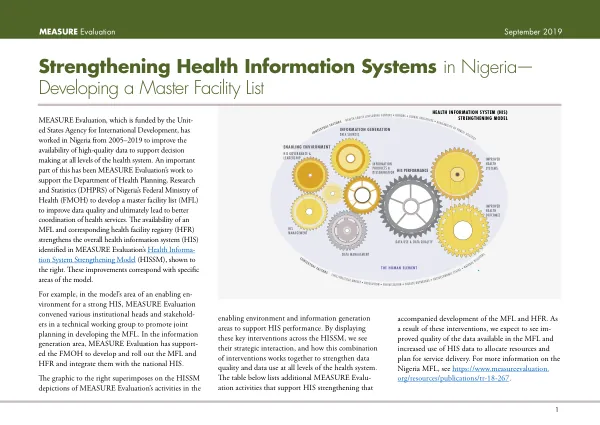
The Health Facility Registry (HFR) serves as the unique source for health facility data in Nigeria, including contact information, geocoordinates, services offered, and composition of health providers.
2019 · 21 pages
Sign in to readA free account is required to download.
Abstract
The HFR database has been customized to capture approval processes in accordance with standard operating procedures (SOPs) developed with the support of the United States Agency for International Development-funded MEASURE Evaluation project. The integration of the HFR with the National Health Management Information System (NHMIS) was prioritized during the development of a monitoring and evaluation (M&E) framework for the implementation of Nigeria's Master Facility List (MFL). Ideally, facility updates with appropriate approvals will be pushed by means of an application programming interface (API) from the HFR to the DHIS 2. Once this integration is complete, no additional changes to the DHIS 2 will be made within that database; rather, requests for modifications to facilities will be submitted and approved through the HFR. A federal team comprising the Core Group of the Master Facility List Technical Working Group (MFL TWG), staff from HISP Nigeria, and representatives from MEASURE Evaluation organized five meetings in October 2018 to align the facility list from the HFR with DHIS 2. Initially, the federal team compared the administrative units (states, LGAs, and wards), which revealed minor discrepancies between the HFR and DHIS 2 lists. Subsequently, facility lists were compared using a unique identifier (ID), which was created by combining the facility, LGA, and state names from each list. The unique IDs from the HFR and DHIS 2 were then compared to each other and facilities were either matched exactly, identified as possible matches, or categorized as unmatched. For facilities found in the DHIS 2 but not in the HFR, the DHIS 2 was reviewed to check reporting status of all unmatched facilities for the period from January to December 2018. Facilities deemed to be regularly reporting in this period were added to the HFR and the rest were excluded. State authorities were then contacted by email and telephone between February and March 2019 to inquire about the remaining possible matches and unmatched facilities. As a result of this activity, both the HFR and the DHIS 2 have been updated to include 41,454 facilities. The health facility alignment process was initiated in October 2018, and different types of discrepancies were observed. Valiant efforts were made to seek verification of health facilities by state authorities, but remote reconciliation of discrepancies proved challenging. Despite these challenges, the alignment process has made significant progress in harmonizing the administrative units and health facility names between the two information systems.