USAID DEC
Strengthening Health Information Systems in Nigeria—Developing a Master Facility List
Sign inCAROLINA POPULATION CENTER AT THE UNIVERSITY OF NORTH CAROLINA AT CHAPEL HILL
Strengthening Health Information Systems in Nigeria—Developing a Master Facility List
Health Information System Strengthening in Nigeria began in 2005 with MEASURE Evaluation's support to the Department of Health Planning, Research and Statistics (DHPRS) of Nigeria's Federal Ministry of Health (FMOH).
2019 · 3 pages
Sign in to readA free account is required to download.
Abstract
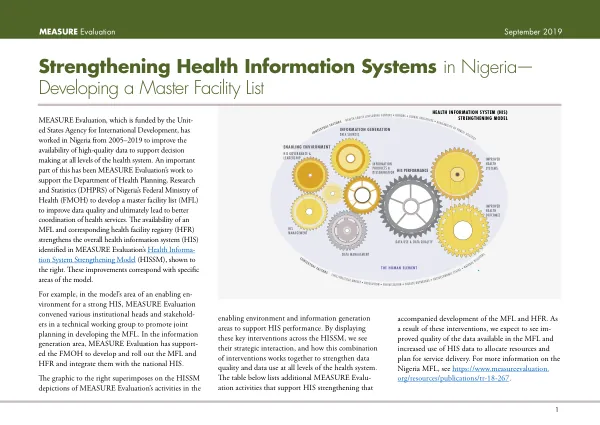
The primary goal was to improve the availability of high-quality data to support decision making at all levels of the health system. MEASURE Evaluation's work focused on developing a master facility list (MFL) and health facility registry (HFR) to enhance data quality and facilitate better coordination of health services. The MFL and HFR were integrated into the national health information system (HIS), strengthening the overall HIS identified in MEASURE Evaluation's Health Information System Strengthening Model (HISSM). This model consists of several key areas, including enabling environment, information generation, data management, and HIS governance and leadership. MEASURE Evaluation's activities in these areas included convening a technical working group to promote joint planning in developing the MFL, supporting the FMOH to develop and roll out the MFL and HFR, and integrating them with the national HIS. MEASURE Evaluation's work in Nigeria also involved supporting the establishment of technical working groups (TWGs) to create and implement the HFR and MFL. These TWGs brought together various stakeholders to coordinate the development and implementation of the MFL and HFR. Additionally, MEASURE Evaluation provided support to the FMOH to establish a Health Data Governance Council meeting and to harmonize and integrate indicators into the national health management information system. The development of the MFL and HFR was accompanied by various activities aimed at improving data management and HIS governance and leadership. These activities included developing guidance and training materials for HFR data collection, training master data collection officers on the HFR, and conducting assessments with HFR system users, administrators, architects, and developers to inform plans for capacity building. MEASURE Evaluation also supported the FMOH to map HFR and District Health Information Software, version 2 (DHIS 2) facilities, which is the first step toward integration of the HFR and DHIS 2. The integration of the MFL and HFR with the national HIS is expected to lead to improved quality of the data available and increased use of HIS data to allocate resources and plan for service delivery. This, in turn, is expected to result in improved health outcomes at all levels of the health system. The development of the MFL and HFR also provides an essential resource for monitoring coverage of health services, facilitating better decision making and resource allocation. MEASURE Evaluation's work in Nigeria has been supported by the United States Agency for International Development (USAID) under the terms of MEASURE Evaluation's cooperative agreement AID-OAA-L-14-00004. The project is implemented by the Carolina Population Center, University of North Carolina at Chapel Hill in partnership with ICF International; John Snow, Inc.; Management Sciences for Health; Palladium; and Tulane University.
Related documents