DEPARTMENT OF HEALTH
Improved Access. Improved Services. Better Health Outcomes.
The Philippine government, through the Universal Health Care (UHC) Act, has implemented significant reforms in the health sector to attain a more equitable financing health mechanism.
2023 · 7 pages
Sign in to readA free account is required to download.
Abstract
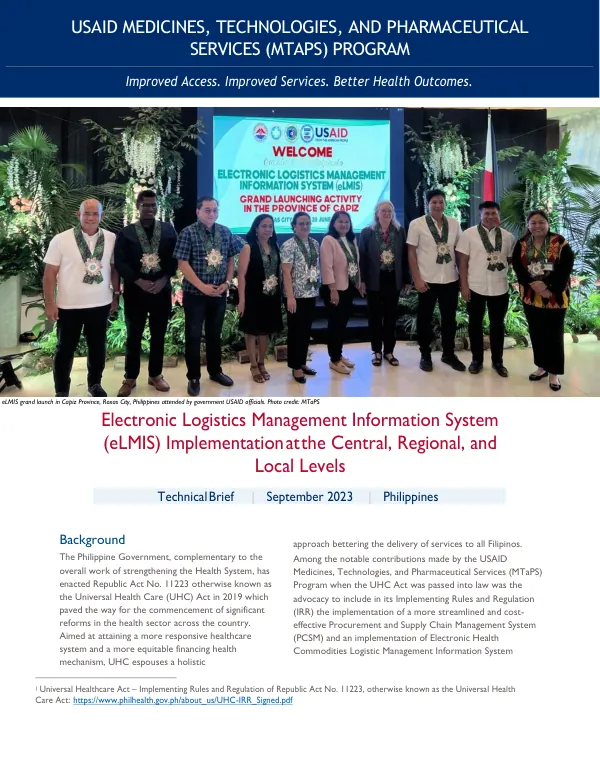
The USAID Medecines, Technologies, and Pharmaceutical Services (MTaPS) Program has provided technical assistance to the Department of Health (DOH) in strengthening the health system. The UHC Act has paved the way for the commencement of reforms, including the implementation of a more cost-effective Procurement and Supply Chain Management System (PCSM) and an Electronic Health Commodities Logistic Management Information System (eLMIS). The DOH has faced challenges in logistics data management, including multiple information systems with inconsistent functionalities, system silos, and lack of interoperability. This has resulted in difficulties in getting a complete and accurate visibility of the overall supply chain across the country, increased costs, and reduced visibility due to multiple information systems working in isolation. The absence of a unified information system for logistics management has hindered the capture of all supply chain data for all essential health commodities from all levels. The MTaPS Program has allocated $1 million for the selection and acquisition of a commercially available off-the-shelf eLMIS and to continuously invest in its institutionalization. The program has developed requirements and organized an exposition to present the requirements to local and international solution providers. The solution provider was selected, and the application was acquired, with MTaPS and DOH co-developing an implementation plan to reconfigure and rollout the eLMIS across the country. The deployment aimed to standardize processes and data across all levels, providing a unified platform for end-to-end supply chain visibility. The eLMIS implementation is one of the building blocks identified in the Local Health System Maturity Level and the overall Procurement and Supply Chain Management (PSCM) roadmap to attain the goals of the UHC Act. MTaPS has assisted DOH in developing policies, including the UHC Implementing Rules and Regulation (IRR), to serve as a foundation for eLMIS implementation. A phased rollout approach was adopted to gauge the system's applicability in different scenarios and provide an opportunity to gather lessons learned and address system and resource needs at all levels. The 5-phase implementation plan includes preparatory activities, such as policy development, process mapping, and system reconfiguration, as well as user training and capacity-building activities. The implementation plan aims to ensure that eLMIS is deployed to sites that are ready and committed to take on the necessary activities to implement the system. Stakeholder engagement has been crucial in the implementation process. MTaPS has developed a cost elements matrix for eLMIS implementation, which has served as an advocacy for cost-sharing mechanisms with partners. As a result, MTaPS was able to leverage $1,242,142 from relevant DOH bureaus and partners, such as the Global Fund's (GF) and World Health Organization (WHO), to reach important milestones in the implementation. The implementation of eLMIS has been a collaborative effort between MTaPS, DOH, and partners. The program has supported the development of policies, process mapping, and system reconfiguration, as well as user training and capacity-building activities. The phased rollout approach has allowed for the gathering of lessons learned and the addressing of system and resource needs at all levels. The implementation of eLMIS is expected to provide a unified platform for end-to-end supply chain visibility, standardize processes and data across all levels, and improve the delivery of health commodities to all Filipinos.