USAID DEC
Improving Livelihoods and Governance through Natural Resource Management in Afghanistan (IGLNRM)
Sign inAFGHANISTAN MINISTRY OF AGRICULTURE, IRRIGATION AND LIVESTOCK
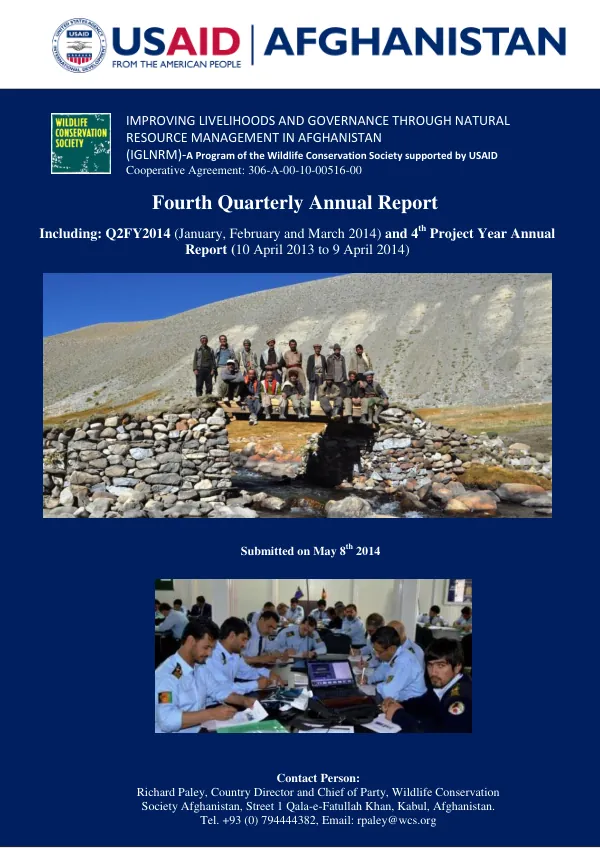
Improving Livelihoods and Governance through Natural Resource Management in Afghanistan (IGLNRM)
Afghanistan's natural resource management is critical to the country's reconstruction efforts, as over 80 percent of the population lives in rural areas and depends on the natural resource base for economic survival.
2014 · 34 pages
Sign in to readA free account is required to download.
Abstract
The most urgent threats to the Afghan environment include over-hunting, deforestation, dry land farming, water diversion, over-grazing, land encroachment, and climate change, which are exacerbated by a growing population and lack of technical capacity to implement sustainable resource management. The IGLNRM project, supported by USAID, aims to ensure community tenure over natural resources and involvement in national parks and protected areas, providing immediate economic benefits without degrading the country's natural resource base. The project focuses on two provinces, Badakhshan and Bamyan, as examples of approaches that could be duplicated in other areas of the country. Community capacity development and training in sustainable management of resources are being implemented, along with building capacity with provincial and national government departments. The project has three key objectives: strengthening community associations to operate as independent, community-led natural resource management institutions; establishing and co-managing the Big Pamir and Teggermansu Wildlife Reserves in Wakhan; and establishing a viable and professional authority for the management of Afghanistan's natural heritage, the Afghan Parks and Wildlife Authority (APWA). The project supports USAID's Strategic Objective SO 5: A Thriving Licit Economy Led by the Private Sector, with results reported under Objective 5: A Sustainable, Thriving Agricultural Environment, and Program Element 5.2: Improved Natural Resource Management as a Result of USG Assistance. The project's geographic areas and components include Bamyan and Badakhshan provinces, as well as a national capacity building component. The technical objectives are cross-cutting and apply in each area, with best practices being disseminated across all regions served. The project aims to build Afghanistan's capacity to conserve and sustainably manage its natural resources, improving the livelihoods of the rural poor in northeast and central Afghanistan and strengthening linkages between local communities and regional and national government institutions. In Bamyan Province, the project has focused on community capacity development and training in sustainable management of resources, with a corresponding building of capacity with provincial and national government departments. The project has also established community associations to operate as independent, community-led natural resource management institutions. In Badakhshan Province, the project has established and co-managed the Big Pamir and Teggermansu Wildlife Reserves in Wakhan, and has strengthened community associations to operate as independent, community-led natural resource management institutions. The project's national capacity building component aims to build the capacity of national government departments, particularly the Ministry of Agriculture, Irrigation and Livestock (MAIL) and the National Environment Protection Authority (NEPA). The project has also established a viable and professional authority for the management of Afghanistan's natural heritage, the Afghan Parks and Wildlife Authority (APWA). The project's results are reported under Objective 5: A Sustainable, Thriving Agricultural Environment, and Program Element 5.2: Improved Natural Resource Management as a Result of USG Assistance. The project's extension will continue to advance communities' capacity for long-term livelihood and governance independence and push the program towards long-term sustainability while significantly strengthening central institutional capacity and linkages with the communities impacted by national level policies and management activities. The extension will not involve any change in the approved objectives or scope of the project, but it will allow WCS and its partners to ensure that the past and current USAID support to natural resource management will achieve enduring results and will constitute a significant contribution towards achieving the US Government's goal of effective Transition by the end of 2014.