USAID DEC
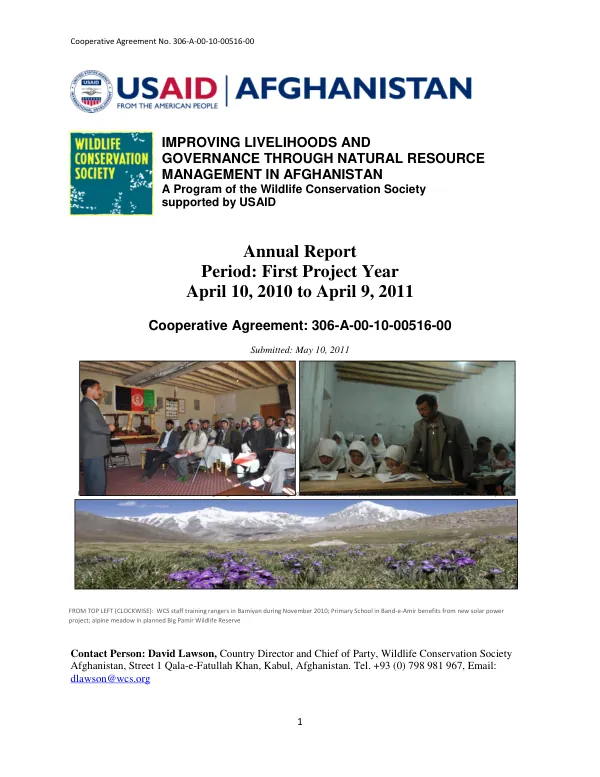
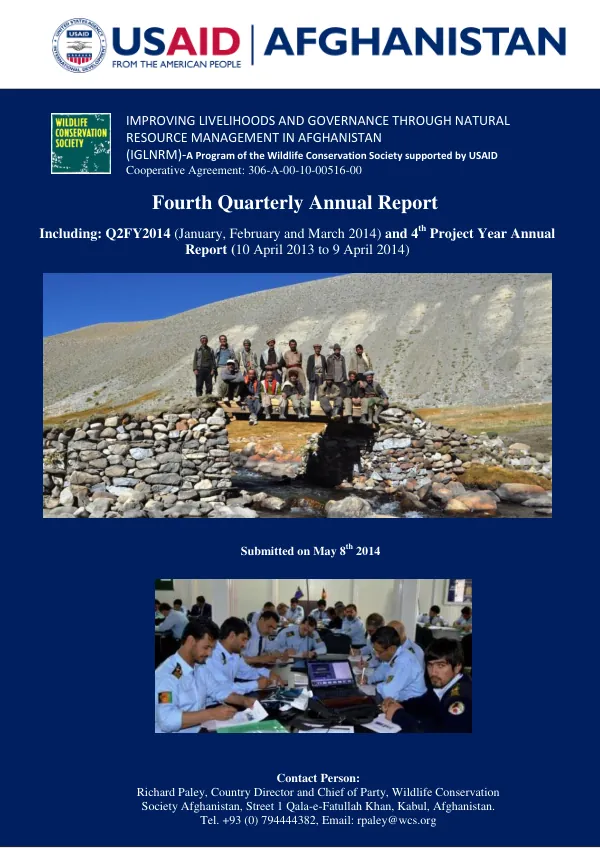
Improving Livelihoods and Governance through Natural Resource Management in Afghanistan
Sign inAFGHANISTAN MINISTRY OF AGRICULTURE, IRRIGATION AND LIVESTOCK
Improving Livelihoods and Governance through Natural Resource Management in Afghanistan
The IGLNRM program in Afghanistan aims to improve livelihoods and governance through natural resource management.
2013 · 44 pages
Sign in to readA free account is required to download.
Abstract
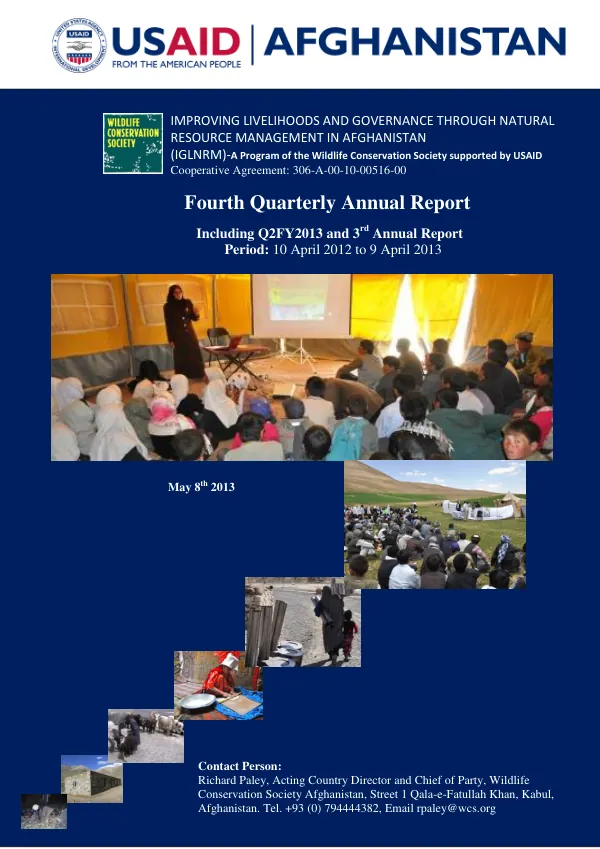
The program is a collaborative effort between the Wildlife Conservation Society and USAID, with a focus on building capacity in two provinces, Badakhshan and Bamyan, as well as at the national level. The program's goal is to ensure community tenure over natural resources and involvement in national parks and protected areas, with a focus on providing immediate economic benefits while improving the natural resource base. The program's approach involves community capacity development and training in sustainable management of resources, as well as building capacity with provincial and national government departments. This capacity building and training is leading to immediate benefits in the short term, such as job creation and critical management skills, and in the medium term, as Afghans develop the ability to sustainably manage the country's natural resource base for economic gains. The program is grouped into two geographically defined areas, Bamyan and Badakhshan, and a national capacity building component. The technical objectives are cross-cutting and apply in each area, and are mutually supporting, with best practices being disseminated across all regions served. The chosen areas are significant in terms of watershed protection and management. Key highlights of the third project year include the establishment of the Afghanistan Parks and Wildlife Authority, which will provide a framework for the management of national parks and protected areas. The program has also made significant progress in building capacity with provincial and national government departments, including the Ministry of Agriculture, Irrigation and Livestock and the National Environment Protection Authority. The program's approach to natural resource management is centered on the principles of sustainable development, with a focus on providing immediate economic benefits while improving the natural resource base. The program's long-term goal is to ensure that Afghanistan develops the capacity to sustainably manage its natural resource base, and the expanded program is designed to advance communities' capacity for long-term livelihood and governance independence. The program supports USAID's Strategic Objective SO 5: A Thriving Licit Economy Led by the Private Sector, and results are reported under Objective 5: A Sustainable, Thriving Agricultural Environment, and Program Element 5.2: Improved Natural Resource Management as a Result of USG Assistance. In terms of geographic areas and components, the program is focused on two provinces, Bamyan and Badakhshan, as well as a national capacity building component. The program's technical objectives are cross-cutting and apply in each area, and are mutually supporting, with best practices being disseminated across all regions served. The program's approach to community capacity development and training involves a range of activities, including training in sustainable management of resources, as well as building capacity with provincial and national government departments. The program's focus on building capacity with government departments is designed to ensure that the program's benefits are sustained over the long term. In terms of implementation, the program is working closely with provincial and national government departments, as well as with local communities, to ensure that the program's benefits are shared equitably. The program's approach to implementation is centered on the principles of participatory development, with a focus on involving local communities in the decision-making process. The program's progress is being monitored and evaluated through a range of indicators, including the number of communities involved in the program, the number of government departments participating in the program, and the level of capacity building achieved. The program's results are reported under Objective 5: A Sustainable, Thriving Agricultural Environment, and Program Element 5.2: Improved Natural Resource Management as a Result of USG Assistance. Overall, the IGLNRM program in Afghanistan is making significant progress in improving livelihoods and governance through natural resource management. The program's approach to community capacity development and training, as well as its focus on building capacity with government departments, is designed to ensure that the program's benefits are sustained over the long term.