CONSERVATION STRATEGY FUND
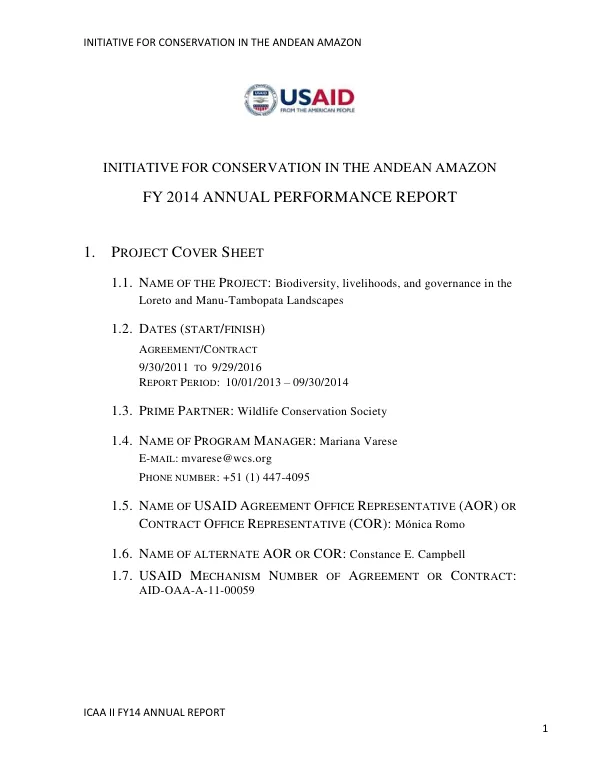
Initiative for Conservation in the Andean Amazon ICAA II FY14 Annual Report
The Initiative for Conservation in the Andean Amazon (ICAA) II FY14 Annual Report focuses on conserving biodiversity, securing rural livelihoods, and promoting the sustainable use of natural resources in the Loreto and Manu-Tambopata landscapes.
2014 · 29 pages
Sign in to readA free account is required to download.
Abstract
The Wildlife Conservation Society (WCS), in partnership with the Sociedad Peruana de Derecho Ambiental (SPDA) and the Fondo de las Américas del Perú (FONDAM), aims to scale up the landscape conservation approach to strengthen the national and regional protected area systems. The project seeks to achieve three main goals: Loreto Landscape Managed Sustainably, Manu-Tambopata Landscape Managed Sustainably, and Strengthened Protected Area Systems. To achieve these goals, the consortium will implement five strategies: securing land and resource-use rights and coordinating effective governance systems, expanding the use of market mechanisms for conservation and sustained poverty alleviation, building natural resource governance skills and experience, building strong and effective constituencies for conservation, and scaling-up landscape conservation to the system level by improving effective management of national and regional protected area systems. During FY14, the consortium improved management of 4.1 million hectares of significance for biodiversity and natural resources, and completed 45 policies, laws, agreements, and regulations (PLARs) to help secure lands under conservation management. The consortium worked with national and sub-national protected area authorities to strengthen their management, supported the consolidation and legitimization of land tenure rights and management of private conservation areas (ACPs) for ribereño and indigenous communities, and strengthened environmental certification processes for investment projects. In the Manu-Tambopata landscape, the consortium promoted the recognition by the National Wildlife and Forestry Service (SERFOR) of the Inambari river headwaters in Quiaca district as a fragile ecosystem, an impact that will result in a change of judicial status for the Polylepis forest. The consortium also conducted a land-use change analysis in the buffer zone of Bahuaja Sonene National Park (PNBS), which was used as a motivation to bring together National Peruvian Service of Natural Protected Areas (SERNANP), Ministry of Environment (MINAM), and the San Pedro de Putina Punco Municipality to collaborate in the development of a municipal Concerted Development Plan (PDC). The consortium also strengthened management of protected areas in the Manu-Tambopata landscape, including monitoring of animal species in different ANP and their buffer zones. In Manu National Park, SERNANP acquired camera traps to begin a jaguar monitoring campaign, and partners collected data on chemical characteristics of water bodies to assess if there is a relationship between water chemistry and healthy otter and arahuana populations. In addition, the consortium supported capacity building of Loreto Regional Government (GOREL) employees in tourism, extractive industries, Environmental Impact Assessments (EIA), environmental oversight, forestry and wildlife legislation, and ANP legislation. The consortium also organized an experience exchange in June 2014 for members of the management committees in the Pacaya-Samiria National Reserve (PSNR) and the Tambopata National Reserve (TNR), which supported sustainable co-management by PA authorities and adjacent communities by strengthening their capacities through horizontal exchanges. At the national level, technical assistance during FY14 revolved around three principal themes: shared conservation object monitoring, planning guidelines for ANPs, and spatial monitoring tools. The consortium supported SERNANP PA planning efforts to assure the adoption of an adaptive management approach, and the guidelines for elaboration, implementation, and evaluation of PA master plans will be published with matching funds. The pilot program for Spatial Monitoring And Reporting Tool (SMART) has begun during FY14, involving 10 PAs for a testing period, after which the consortium will assess whether this tool can be expanded for the rest of the PAs. The consortium also supported legal recognition and titling processes for three communities adjacent to the Tamshiyacu Tahuayo Communal Regional Conservation Area (ACRCTT) – El Chino, Miraflores, and Buena Vista – during FY14. The implementation of the ACRCTT Management Committee’s Annual Plan complemented this work for sustainable management with the consortium’s support in doing a critical review of local wildlife use agreements, new economic alternatives needed for the communities, and the incorporation of new members to the committee, in partnership with the Loreto Regional Conservation Program (PROCREL). The consortium’s direct support to the largest conservation concession in Peru (Los Amigos, LACC) includes long fluvial and terrestrial patrols, which have helped to reduce deforestation and habitat fragmentation in the area. Overall, the consortium has made significant progress in conserving biodiversity, securing rural livelihoods, and promoting the sustainable use of natural resources in the Loreto and Manu-Tambopata landscapes during FY14.