CARANA CORPORATION, INC.
GTIS Quarterly Progress Report
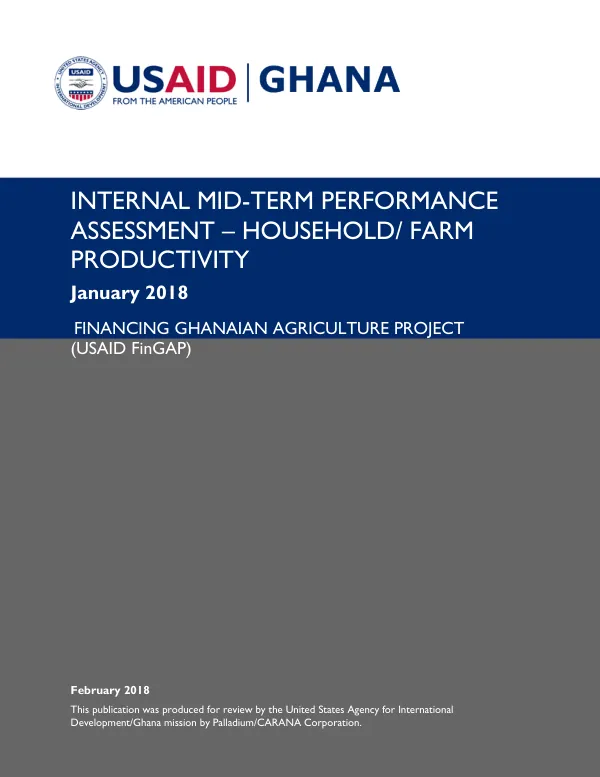
The USAID Financing Ghanaian Agriculture Project (USAID FinGAP) is a five-year project that facilitates finance and investment in the maize, rice, and soy value chains in northern Ghana.
2018 · 9 pages
Sign in to readA free account is required to download.
Abstract
The project contributes to USAID's overall goal of fostering broad-based, sustained, and inclusive economic growth in Ghana. USAID FinGAP aims to strengthen the program and advocate for expanded private sector investment in staple food agriculture in Ghana. A mixed-methods approach was used to assess the firm-level outcomes of USAID FinGAP interventions for the range of beneficiaries supported by the project. Two surveys were carried out with 293 small, medium, including large enterprises (SMiLEs) and 481 male and female smallholder farmers. In-depth interviews and focus group discussions were held with SMiLEs, smallholder farmers, community leaders, financial institutions, and business advisory services providers to provide context. Key findings related to household/farm productivity and profitability indicate that profits increased for smallholder farmers and SMiLEs in the rice and maize value chains between 2013 and 2016. Average profits for SMiLEs in the rice value chain increased by 55% from GHc 11,500 to GHc 17,770, and profits for those in maize increased by 64% from GHc 19,402 to GHc 31,758. Smallholder rice profits increased by 12% from GHc 921 to GHc 1,027, and maize profits increased by 25%, from GHc 885 to GHc 1,106. The number of smallholders from whom SMiLEs buy rice, maize, and soy increased by 55%. SMiLEs and smallholder farmers engaged in maize and rice value chains increased the number of paid full-time and part-time jobs for women and men between 2013 and 2016. On average, SMiLEs hired 13% more laborers in 2016 (11,556 laborers) compared with 2013 (10,272 laborers) and smallholder farmers hired 18% more laborers during the same period from 557,205 in 2013 to 658,515 in 2016. SMiLEs supported by USAID FinGAP owned an average of 141 acres of land in 2016, which remained unchanged since 2013. However, there is diversity in SMiLE land ownership across the project's regions. For example, SMiLEs in the Upper East Region own 211 acres on average, which is 50% more land than those in other regions. The biggest change in land ownership for smallholder farmers took place in the Upper West Region, with a 29% increase in land ownership from 15.3 acres per household in 2013 to 19.7 acres in 2016. Maize is the leading crop produced by SMiLEs and smallholder farmers across the country, due to low production costs, the availability of a ready market, and the fact that it's a staple crop for household consumption. In addition to maize, producers cultivated rice and soya. There was a slight increase in the proportion of smallholder farmers cultivating any crop, from 144 farmers in 2013 to 150 in 2016. Maize is typically produced in the Upper West Region, rice in the Upper East Region, and soya in the Northern Region. Smallholder farmers produced and sold more maize and rice in 2016 than they did three years ago. On average, smallholders sold 19.6 bags of maize in 2013 compared to 21.3 in 2016. Smallholders sold 19 bags of rice in 2013 compared to 24 in 2016. This was largely due to improved agronomic practices, increased financial support, and better linkages to traders. However, there was a 7% decrease from 8.4 to 7.9 bags of soya produced by smallholder farmers across regions, with the exception of the Upper West region, where soya production increased by 38%. Reasons cited for the decrease in soya production were low levels of mechanization in the shelling of soya and limited market availability. SMiLEs reported similar increases in volumes of maize produced, from 2,149 bags in 2013 to 2,843 in 2016 (a 30% increase), as well as volumes of rice, from 213 bags to 274 bags (a 29% increase). Producer SMiLEs attribute their increased production to USAID FinGAP support. All value chain actors ranked access to markets as the number one challenge facing farmers, followed by low demand for local rice.