USAID DEC
Improving the lives of vulnerable children in Kenya Experiences from implementing quality service standards
Sign inBROAD BRANCH ASSOCIATES
Improving the lives of vulnerable children in Kenya Experiences from implementing quality service standards
Quality Improvement in Programs for Vulnerable Children in Kenya is a critical issue, given the estimated 2.6 million Orphans and Vulnerable Children (OVC) in the country.
2013 · 48 pages
Sign in to readA free account is required to download.
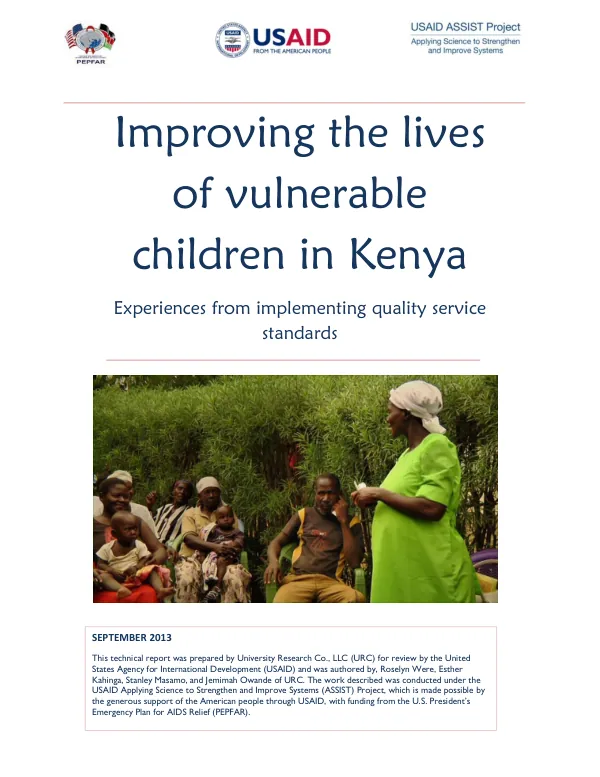
Abstract
The rising poverty levels, high cost of living, and children orphaned due to HIV and AIDS have exacerbated the problem. To address this, the Kenya Government, in collaboration with development partners, developed the Minimum Service Standards for Quality Improvement of Vulnerable Children Programmes in Kenya, launched in 2012. These standards aim to harmonize interventions by stakeholders, ensure fair distribution of services, and provide a framework for monitoring and evaluating the impact of programs serving vulnerable children. The USAID Applying Science to Strengthen and Improve Systems (ASSIST) Project has been working with implementing partners to mainstream Quality Improvement (QI) at the point of service delivery through institutionalizing the Minimum Standards for QI of vulnerable children programs. The project has been working with the AIDS Population and Health Integrated Assistance (APHIA) and AMPATH Plus in several counties, including APHIA Plus Western, APHIA Plus Kamili, AMPATH, APHIA Plus Nairobi Coast, and APHIA Plus Nuru ya Bonde. These partners have program components that provide care and support to orphans and vulnerable children in the areas they operate. In Kenya, Civil Society Organizations (CSOs), comprising Faith Based Organizations (FBOs), Community Based Organizations (CBOs), Community Units (CUs), and Non Governmental Organizations (NGOs), play a crucial role in delivering quality care to vulnerable children in the community. Caring for vulnerable children under the community banner delivers better results than putting them in foster homes, which are often inaccessible to a majority of them. Historically, CSOs working with development partners to meet the needs of vulnerable children simply supplied items they thought the children needed without assessing their needs. However, with the introduction of the Minimum Service Standards, CSOs have been encouraged to adopt a more holistic approach to caring for vulnerable children. This includes assessing the needs of the children, providing a range of services, and ensuring that the services are delivered in a way that is responsive to the needs of the children and their families. The implementation of the Minimum Service Standards has led to significant improvements in the quality of care provided to vulnerable children. For example, in APHIA Plus Western, the implementation of the standards led to a 60% increase in the number of children receiving psychosocial support, while in APHIA Plus Kamili, the implementation of the standards led to a 40% increase in the number of children receiving education and vocational training. The success of the Minimum Service Standards in improving the quality of care provided to vulnerable children in Kenya is a testament to the importance of collaboration and coordination among stakeholders. The standards have provided a framework for monitoring and evaluating the impact of programs serving vulnerable children, and have encouraged CSOs to adopt a more holistic approach to caring for vulnerable children. As the number of OVC in Kenya continues to rise, the implementation of the Minimum Service Standards will be critical in ensuring that these children receive the care and support they need to thrive. The Child Status Index (CSI) has been used to assess the well-being of vulnerable children in Kenya. The CSI is a tool that measures the well-being of children in five domains: health, education, protection, family and community, and economic well-being. The CSI has been used to identify areas where children are most vulnerable and to develop targeted interventions to address these needs. The Self-Assessment Tool has also been used to assess the quality of care provided to vulnerable children in Kenya. The tool is used to assess the quality of care in five domains: leadership and management, program design and implementation, monitoring and evaluation, community engagement, and financial management. The tool has been used to identify areas where programs are strong and areas where improvement is needed. In conclusion, the implementation of the Minimum Service Standards for Quality Improvement of Vulnerable Children Programmes in Kenya has led to significant improvements in the quality of care provided to vulnerable children. The standards have provided a framework for monitoring and evaluating the impact of programs serving vulnerable children, and have encouraged CSOs to adopt a more holistic approach to caring for vulnerable children. As the number of OVC in Kenya continues to rise, the implementation of the Minimum Service Standards will be critical in ensuring that these children receive the care and support they need to thrive.