USAID DEC
In the shadows: Phylogenomics and coalescent species delimitation unveil cryptic diversity in a Cerrado endemic lizard (Squamata: Tropidurus)
Sign inOPEN UNIVERSITY
In the shadows: Phylogenomics and coalescent species delimitation unveil cryptic diversity in a Cerrado endemic lizard (Squamata: Tropidurus)
The Cerrado, a savanna biome in South America, is home to a high level of biodiversity, with many species of lizards, including the genus Tropidurus, being endemic to the region.
2017 · 11 pages
Sign in to readA free account is required to download.
Abstract
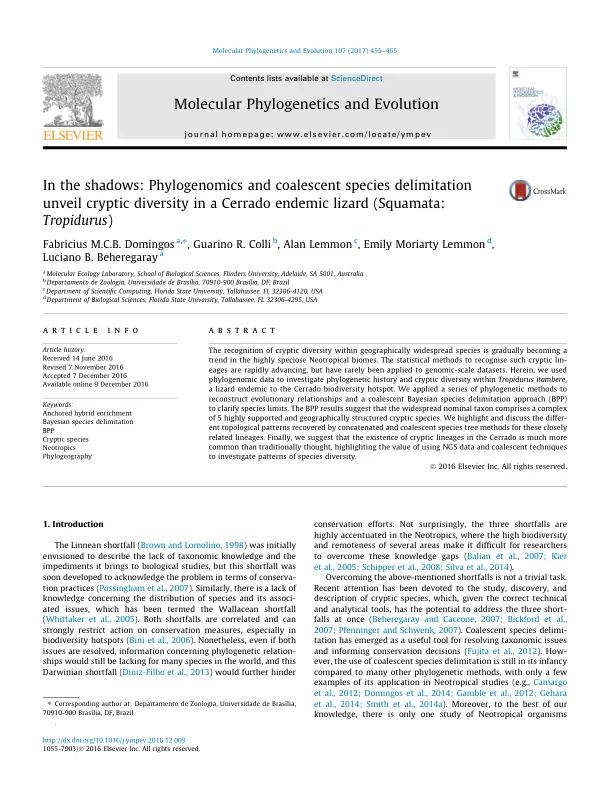
Tropidurus itambere, a species of lizard, is found in the Cerrado and has been the subject of recent studies on its phylogenetic history and cryptic diversity. The species is diagnosed by the presence of deep mite pockets in the inguinal region and on the side of the neck, but there is great variation in the depth and form of these pockets between populations. Phylogenetic analyses have been conducted on Tropidurus species, including a study by Frost and colleagues in 2001, which used mtDNA and morphological data to propose phylogenetic hypotheses for the genus. However, these studies have been limited by the lack of a modern taxonomic revision and the limited sampling of earlier molecular phylogenetic reconstructions. Recent studies have suggested that unrecognised species complexes exist within the genus, which hinders a thorough attempt to reconstruct the phylogenetic history of Tropidurus. A coalescent species delimitation method and a series of phylogenetic analyses were applied to test whether the morphological and geographical variation observed among Cerrado T. itambere populations reflects genome-wide divergences. The study used an anchored hybrid enrichment phylogenomic approach to obtain a robust dataset of over 400 loci. The results suggest that T. itambere populations can be assigned to 5 well-supported cryptic species. The coalescent species tree estimated using BPP retrieved a slightly different topology compared to concatenated and other coalescent phylogenetic reconstruction methods for these closely related species. The study highlights the potential advantages of applying coalescent species delimitation methods to a robust dataset of loci obtained by an anchored hybrid enrichment phylogenomic approach. This approach can assist in the detection of different lineages in non-model organisms, avoid problems associated with not sampling the possibly different demographic histories retrieved by different loci, and reduce the probability of delimitation errors when using coalescent species delimitation methods. The study also suggests that the existence of cryptic lineages in the Cerrado is much more common than traditionally thought, highlighting the value of using NGS data and coalescent techniques to investigate patterns of species diversity. The Cerrado is a biodiversity hotspot, with many species of lizards being endemic to the region. The study of Tropidurus itambere and its cryptic diversity provides new insights into the phylogenetic history of the genus and highlights the importance of using coalescent species delimitation methods to investigate patterns of species diversity. The results of the study have implications for conservation efforts in the Cerrado, where the existence of cryptic lineages can have significant implications for the management of biodiversity. The study's findings suggest that the use of coalescent species delimitation methods can provide a more accurate understanding of species diversity in the Cerrado. The approach used in the study can be applied to other species in the region, providing new insights into the phylogenetic history of the Cerrado's endemic species. The study's results also highlight the importance of continued research into the phylogenetic history of Tropidurus and other Cerrado endemic species, in order to better understand the patterns of species diversity in the region.
Related documents