USAID DEC
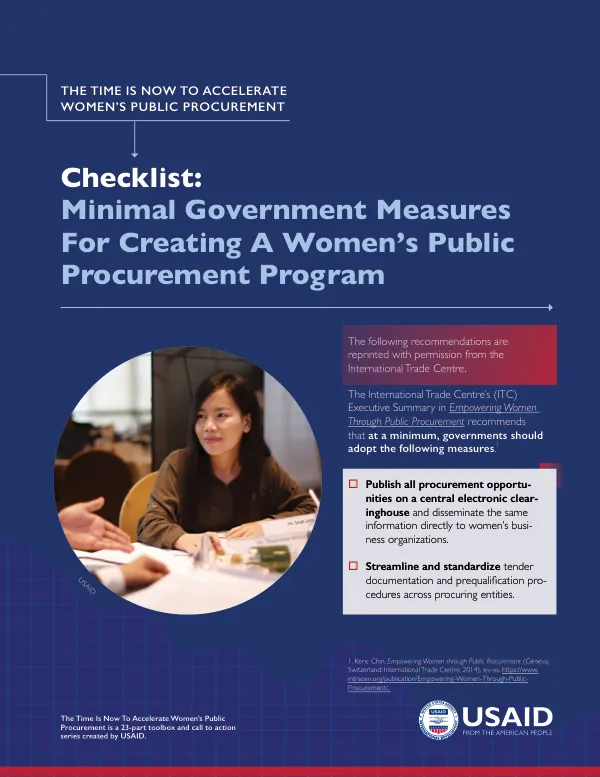
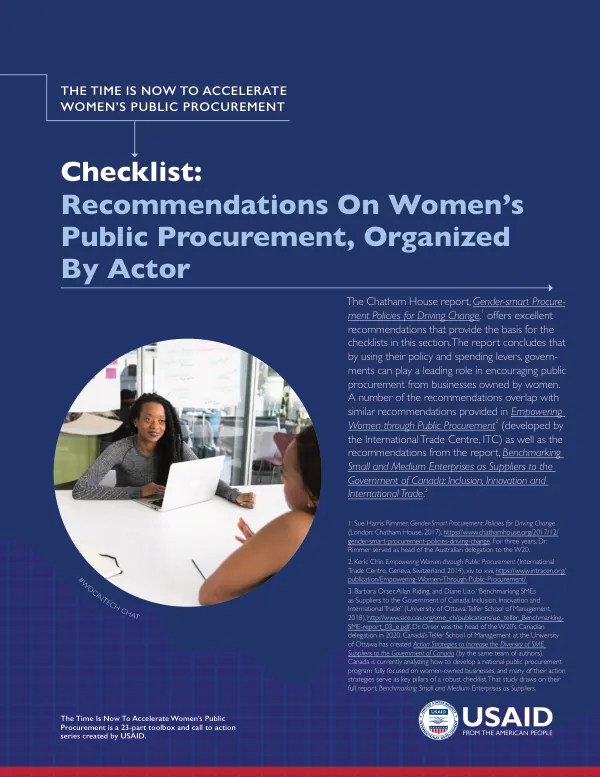
The Time is Now to Accelerate Women's Public Procurement: Checklist: Recommendations on Women's Public Procurement, Organized By Actor
Sign inUSAID
The Time is Now to Accelerate Women's Public Procurement: Checklist: Recommendations on Women's Public Procurement, Organized By Actor
The report emphasizes the importance of governments playing a leading role in encouraging public procurement from businesses owned by women.
2021 · 8 pages
Sign in to readA free account is required to download.
Abstract
Governments can examine their own procurement policies and practices to ensure sustainable and inclusive procurement. Clear definitions of women-owned and women-led businesses are necessary to establish program eligibility, construct comparable program reporting metrics, and reduce the likelihood of tokenism and fraud. Governments can set a political strategy to accelerate gender-equity goals through public procurement. This includes translating the United Nations High-Level Panel on Women's Economic Empowerment into domestic policy and creating a government 'cartel' through the roll-out of gender-smart procurement policies. Governments can also define "women-owned business" and set a target level of procurement spending that should go to businesses owned by women. Governments can offer preferential treatment for companies that apply rigorous gender equality and diversity policies. They can also require firms to disclose information about gender pay equity in bidding for procurement contracts. Support for third-party certification of women-owned businesses is also recommended, as self-certification is problematic. Governments can review SME procurement program eligibility to ensure that qualifying criteria do not defeat opportunities for diverse suppliers, such as women-owned businesses. Governments can increase collaboration among federal agencies tasked with supporting the status of women, immigration, economic development, innovation, entrepreneurship, and international trade. This includes the use of universal federal gender-based analysis (GBA+) budgeting, procedures, regulatory, and program impact analyses, and procurement management. Governments can also work with sub-national agencies, companies, and organizations to understand the diversity of SME suppliers. Governments can drive equal representation of women and men as procurement professionals. They can develop a public database of women suppliers and open government contracts. Governments can also reduce barriers to women's participation in the economy by creating support mechanisms for businesses owned by women to flourish. This includes identifying any barriers to women's business/property ownership, access to finance, direct control of business, and making information available about education and certification processes. The report emphasizes the importance of governments taking a proactive role in promoting women's economic empowerment through public procurement. By implementing these recommendations, governments can create a more inclusive and sustainable procurement system that benefits women-owned businesses and the broader economy.
Related documents