USAID DEC
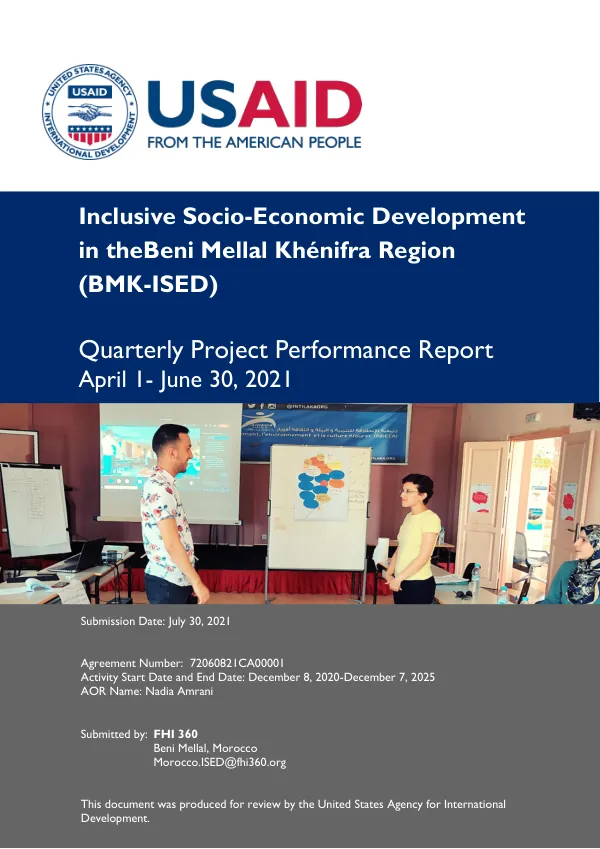
Inclusive Socio-Economic Development in the Beni Mellal Khénifra Region (ISED-BMK) Quarterly Project Performance Report January 1-March 31, 2021
Sign inFHI 360
Inclusive Socio-Economic Development in the Beni Mellal Khénifra Region (ISED-BMK) Quarterly Project Performance Report January 1-March 31, 2021
The Inclusive Socio-Economic Development in the Beni Mellal Khénifra Region (ISED-BMK) project aims to address socio-cultural and economic constraints holistically in the BMK region.
2021 · 33 pages
Sign in to readA free account is required to download.
Abstract
The project is a result of co-designing an initiative between USAID and regional stakeholders to achieve sustainable and equitable accelerated growth. The project's vision is to achieve faster, more inclusive, and sustainable growth by 2025, where vulnerable and marginalized populations benefit disproportionately. The ISED-BMK project is structured into two components. Component 1 focuses on improving governance and citizen participation, while Component 2 addresses livelihood opportunities and economic growth. The project's approach is based on the understanding that improved governance and livelihood opportunities are closely linked and are most effectively addressed through an integrated approach that ensures the inclusion of citizens and all stakeholders from the region. The project's start-up phase, which took place from January 1 to March 31, 2021, was dominated by staff recruitment, strategic planning, securing office space, making initial contacts with stakeholders, organizing an official project launch, and developing working relationships among staff, partners, and USAID. The quarter was significant for the generally smooth start-up process despite the challenges of having new staff working remotely due to the pandemic and the sensitivity of some of ISED-BMK's activities during an election year. During the third quarter (April-June), ISED-BMK expects to move robustly into full implementation with the initiation of activities described primarily in Section IV below. The success of these initiatives will depend not only on how well each activity is carried out but also on how all of them, taken together, produce change that is systemic and sustainable, opening pathways to institutionalize and scale-up results that directly and manifestly benefit women, youth, people with disabilities, and other populations. The project's innovations in participatory governance, creative and in-depth backstopping of civil society organizations, support for the business "ecosystem" that will promote investment, expand market opportunities, and create jobs; provision of grants at the communal level to implement community-defined projects, and the ISED-BMK co-implementation process where stakeholders are full partners – these, in combination, will offer ISED-BMK an optimal environment for maximizing its impact. The ISED-BMK project has a strong emphasis on innovation and piloting to demonstrate new ways of programming, creative ways to build synergies between governance and economic growth, and to experiment with approaches that may serve as a model for other regions. The project's theory of change is based on the understanding that improved governance and livelihood opportunities are closely linked and are most effectively addressed through an integrated approach that ensures the inclusion of citizens and all stakeholders from the region. The project's structure includes a strong focus on stakeholder engagement, with a commitment to co-implementation activities with the full engagement of BMK stakeholders (government, civil society, private sector, and the academic community). The project's vision includes a strong emphasis on innovation and piloting to demonstrate new ways of programming, creative ways to build synergies between governance and economic growth, and to experiment with approaches that may serve as a model for other regions. The ISED-BMK project has a clear understanding of the socio-economic challenges facing the BMK region and has developed a comprehensive approach to address these challenges. The project's start-up phase has been significant, and the project is now moving into full implementation with a range of activities aimed at improving governance, livelihood opportunities, and economic growth. The project's innovations and emphasis on stakeholder engagement offer an optimal environment for maximizing its impact and achieving its vision of faster, more inclusive, and sustainable growth by 2025.
Related documents