USAID
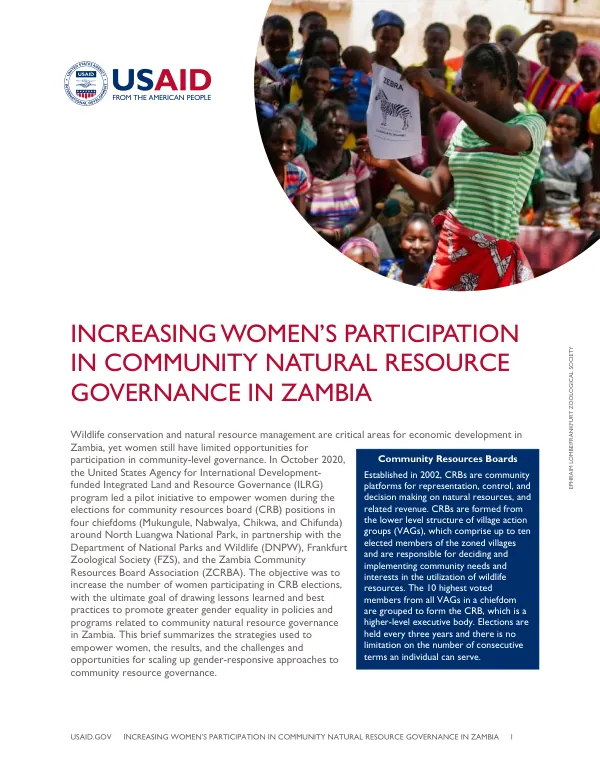
Increasing Women’s Participation in Community Natural Resource Governance in Zambia
Wildlife conservation and natural resource management are critical areas for economic development in Zambia.
2021 · 7 pages
Sign in to readA free account is required to download.
Abstract
Women still have limited opportunities for participation in community-level governance. In October 2020, the United States Agency for International Development-funded Integrated Land and Resource Governance (ILRG) program led a pilot initiative to empower women during the elections for community resources board (CRB) positions in four chiefdoms around North Luangwa National Park. Community Resources Boards (CRBs) are community platforms for representation, control, and decision making on natural resources. CRBs are formed from the lower level structure of village action groups (VAGs), which comprise up to ten elected members of the zoned villages. The 10 highest voted members from all VAGs in a chiefdom are grouped to form the CRB, which is a higher-level executive body. Research shows that women and men have distinct social roles and responsibilities regarding their access to and control of natural resources. Women frequently do not equally share in the economic benefits derived from natural resources, and resource depletion often impacts them disproportionately. Women face several barriers to participation in natural resource governance, including rules that govern community resource groups, social and cultural norms, competing priorities, and lack of support from spouses and extended family. Evidence from several countries shows that inclusion of women in natural resource governance has significant positive effects on conservation and development outcomes. A comparative study in East Africa and Latin America found the presence of women in community forest governance structures to enhance responsible behavior and forest sustainability. In Asia, increasing women's representation in community forest governance institutions improved resource conservation and forest regeneration. Women's participation in community resource governance in Zambia remains significantly low. The legal and policy framework promotes devolution approaches and community involvement in the management and conservation of natural resources. However, progress in policies has not been reflected in community governance in the sector. Programs and strategies have failed to adopt gender-responsive approaches and consider the unique concerns, needs, and knowledge of women and men. Based on recommendations from an earlier gender assessment of the wildlife sector in Zambia, ILRG and local partners implemented a range of interventions before, during, and after CRB elections within four chiefdoms to mitigate gendered barriers and to increase the opportunities for women to equally and fully participate in the election process. A total of 150 women across the four chiefdoms were mobilized and offered training to equip them with skills to go through the election process and potentially take on community leadership roles. In the four chiefdoms, 287 people were nominated in the elections, out of which 150 were women (52 percent). A total of 252 people were elected to the VAGs, including 125 women (50 percent). Although a considerable proportion of those elected at the VAG level were women, they struggled to be among those who received the highest number of votes and secure a place in the CRB. However, the results were impressive comparing results from 2017 with the 2020 elections.
Related documents
Documents in this collection
 2021
2021USAID DEC
Possible Research and Evaluation Questions, and Candidate Indicators, to Consider When Attempting to Measure Commitment in a Ugandan Community
Open record 2020
2020USAID DEC