USAID DEC
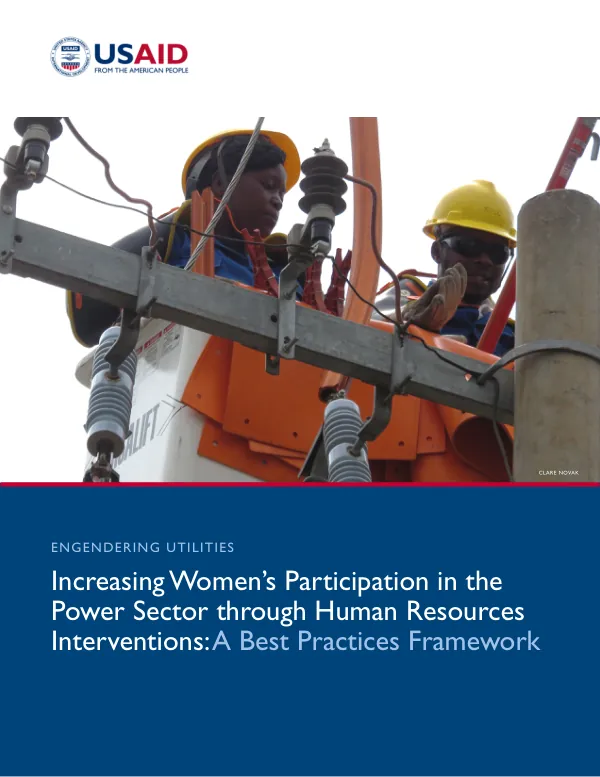
Increasing Women’s Participation in the Power Sector through Human Resources Interventions: A Best Practices Framework
Sign inRTI INTERNATIONAL
Increasing Women’s Participation in the Power Sector through Human Resources Interventions: A Best Practices Framework
Women represent half of the world's employment potential, and effectively developing this talent is crucial for ensuring organizational competitiveness in the future.
2018 · 50 pages
Sign in to readA free account is required to download.
Abstract
A growing body of evidence demonstrates a correlation between diversity at the executive level and a company's performance. A recent study by McKinsey analyzed more than 1,000 companies in 12 countries and concluded that gender-diverse companies are more likely to outperform their national industry average in terms of profitability. Despite the evidence demonstrating women's value in the workforce, women continue to encounter structural barriers to participating in the world economy, particularly in industries traditionally dominated by men. Globally, the labor force participation rate for women is 26.7 percent lower than the rate for men. On average, women work fewer hours for pay or profit either because they opt to work part-time or because part-time work is the only option available to them. In some countries, gender gaps in hourly wage rates for similar work can reach 40 percent. The U.S. Agency for International Development (USAID) is committed to promoting gender equality and women's empowerment and strengthening the energy sector to fuel economic growth and social development. Through its Engendering Utilities program, USAID identified the human resources (HR) employee life cycle as a key entry point to effecting long-lasting and impactful change within partner utilities. From hiring and recruitment to retirement and succession planning, HR interventions represent significant opportunities to promote gender equity within utilities. This Best Practices Framework provides utilities with global best practices and practical resources to identify gaps, define objectives, and establish a roadmap for sustained progress in integrating gender equity throughout their operations and corporate structures. The framework is divided into seven HR categories of the HR life cycle: attracting and hiring, compliance and reporting, payroll and administration, employee development, financial benefits, risk management, and separation and retirement. A special section focusing on key HR policies was also incorporated into the framework. Within each HR category, multiple best practices are outlined that are derived from an extensive literature review of global resources and complemented by lessons learned from USAID's Engendering Utilities program. A description is provided for each best practice, as well as potential implementation challenges, examples of successful implementation, and tools, resources, and templates that provide additional information on each best practice. The target audience for this framework includes decision makers in utilities, including HR and operations professionals, as well as development practitioners, gender experts, and technical advisors throughout the energy sector. This framework can be used as a standalone guide for organizations looking to enhance gender equity by identifying gaps in their current practices and taking concrete steps toward implementing sustainable change. Increasing gender equity and opportunities for women in the economy not only establish a foundation for increasing prosperity and economic growth around the world but also lead to increased gender equality and women's empowerment. The World Economic Forum's Global Gender Gap Report found that, in absolute terms, earned incomes of both men and women have been increasing. However, this upward trend has been hindered by persistent gender gaps in various areas, including economic participation and opportunity, educational attainment, health and survival, and political empowerment. The framework addresses issues related to both equity and equality, jointly referred to as "gender equity" to ensure consistency. Definitons for equality and equity can be found in the glossary in Annex II. The framework provides a comprehensive guide for utilities to promote gender equity throughout the HR life cycle, from attracting and hiring to separation and retirement. By implementing these best practices, utilities can create a more inclusive and equitable work environment that benefits both women and men.