USAID DEC
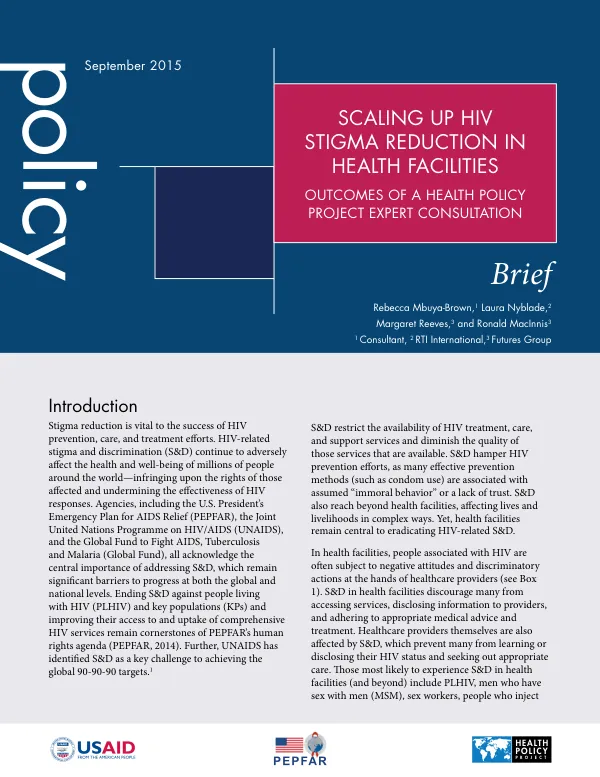
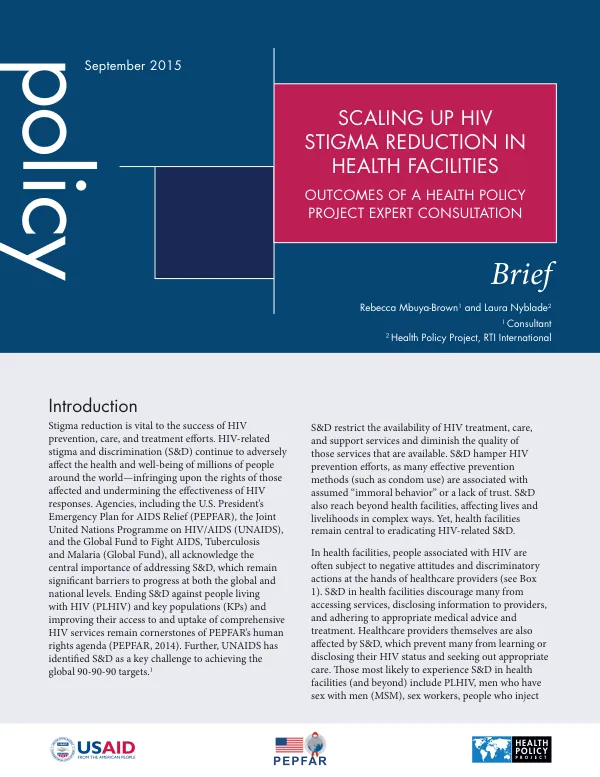
Scaling Up HIV Stigma Reduction in Health Facilities: Outcomes of a Health Policy Project Expert Consultation
Sign inGLOBAL FUND
Scaling Up HIV Stigma Reduction in Health Facilities: Outcomes of a Health Policy Project Expert Consultation
Scaling up HIV stigma reduction in health facilities is crucial to the success of HIV prevention, care, and treatment efforts.
2015 · 12 pages
Sign in to readA free account is required to download.
Abstract
HIV-related stigma and discrimination continue to adversely affect the health and well-being of millions of people worldwide, infringing upon the rights of those affected and undermining the effectiveness of HIV responses. Agencies such as the U.S. President's Emergency Plan for AIDS Relief (PEPFAR), the Joint United Nations Programme on HIV/AIDS (UNAIDS), and the Global Fund to Fight AIDS, Tuberculosis and Malaria (Global Fund) acknowledge the central importance of addressing stigma and discrimination, which remain significant barriers to progress at both the global and national levels. Health facilities play a critical role in eradicating HIV-related stigma and discrimination. People associated with HIV are often subject to negative attitudes and discriminatory actions at the hands of healthcare providers. Stigma and discrimination in health facilities discourage many from accessing services, disclosing information to providers, and adhering to appropriate medical advice and treatment. Healthcare providers themselves are also affected by stigma and discrimination, which prevent many from learning or disclosing their HIV status and seeking out appropriate care. Those most likely to experience stigma and discrimination in health facilities include people living with HIV, men who have sex with men, sex workers, people who inject drugs, transgender persons, and migrants. The Health Policy Project (HPP) has worked in collaboration with global and country-level institutions to advance understanding and approaches to measuring and addressing HIV-related stigma. At the global level, HPP led efforts to review, prioritize, adapt, test, and synthesize existing measures and programmatic tools for stigma reduction in health facilities. This resulted in the development of a comprehensive package for "stigma-free" health facilities, which targets all health facility staff and offers a complete response to stigma and discrimination in health facilities. The package was piloted in several Caribbean countries and offers a total facility approach that includes research, action, and monitoring. In an effort to facilitate further scale-up and refinement of stigma reduction approaches, HPP convened an expert meeting in Washington, DC on June 3, 2015, to discuss and strategize a way forward to scale up stigma-reduction efforts in health facilities. The consultation was organized around six key themes central to adapting and scaling up stigma reduction efforts: implementation and service delivery strategies, health sector governance and accountability, leadership and political will, stakeholder engagement, research and evaluation, and attention to key populations. Participants emphasized the central importance of finding ways to integrate stigma reduction into existing systems and services. They recommended searching for opportunities to integrate stigma indicators and approaches into already funded initiatives and making better use of existing systems, including integrating stigma reduction into pre-service and in-service training curricula for health workers, standards of care, supervisory standards, performance reviews, and codes of conduct. Participants also saw stigma reduction as a quality of care issue and emphasized the need for continuous quality monitoring that integrates stigma indicators. They pointed out the need to use integration to enhance accountability and improve quality of care, and to educate and empower clients to demand high-quality care.