USAID DEC
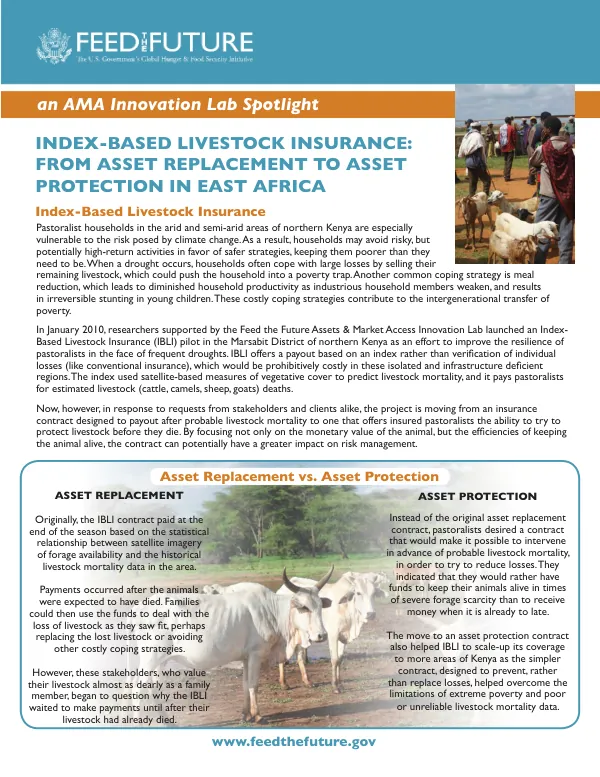
Index-Based Livestock Insurance: From Asset Replacement to Asset Protection in East Africa
Sign inAFRICARE, INC.
Index-Based Livestock Insurance: From Asset Replacement to Asset Protection in East Africa
Index-Based Livestock Insurance: From Asset Replacement to Asset Protection in East Africa The arid and semi-arid areas of northern Kenya are particularly vulnerable to the risks posed by climate change, leading pastoralist households to adopt safer strategies that keep them poorer than they need to be.
2016 · 2 pages
Sign in to readA free account is required to download.
Abstract
When droughts occur, households often cope with large losses by selling their remaining livestock, which can push them into a poverty trap. Another common coping strategy is meal reduction, resulting in diminished household productivity and irreversible stunting in young children. These costly coping strategies contribute to the intergenerational transfer of poverty. In January 2010, researchers launched an Index-Based Livestock Insurance (IBLI) pilot in the Marsabit District of northern Kenya to improve the resilience of pastoralists in the face of frequent droughts. IBLI offers a payout based on an index rather than verification of individual losses, which would be prohibitively costly in these isolated and infrastructure-deficient regions. The index used satellite-based measures of vegetative cover to predict livestock mortality and pays pastoralists for estimated livestock deaths. Initially, the IBLI contract paid at the end of the season based on the statistical relationship between satellite imagery of forage availability and historical livestock mortality data in the area. Payments occurred after the animals were expected to have died, allowing families to use the funds to deal with the loss of livestock as they saw fit. However, stakeholders began to question why the IBLI waited to make payments until after their livestock had already died. In response to requests from stakeholders and clients, the project moved from an insurance contract designed to payout after probable livestock mortality to one that offers insured pastoralists the ability to try to protect livestock before they die. By focusing not only on the monetary value of the animal but the efficiencies of keeping the animal alive, the contract can potentially have a greater impact on risk management. This change made contract design simpler and scaling-up much more feasible and efficient, allowing the IBLI program to develop contracts for all 14 Arid and Semi-Arid counties in Kenya relatively quickly. The asset protection contract has been adopted by the Government of Kenya under its Kenya Livestock Insurance Program (KLIP), which provides insurance for targeted individuals in Northern Kenya, with possible subsidies to the general public in the future. This is an important endorsement and upscaling of the IBLI product that can be partly credited to this transition from asset replacement to asset protection. A similar program in Ethiopia has also moved to the asset protection contract, as stakeholders and clients alike prefer early intervention for asset protection. Already, the asset protection contract has been very well accepted, with pastoralists, their leadership, and the insurance companies offering the product all seeming to have a strong preference for intervening before livestock loss.
Related documents