INTERNATIONAL LIVESTOCK RESEARCH INSTITUTE
Evaluating the Case for National Disaster Risk Insurance
National disaster risk insurance is a proactive approach to financing social protection, particularly in developing countries where natural disasters can create dire hardships for rural families.
2021 · 2 pages
Sign in to readA free account is required to download.
Abstract
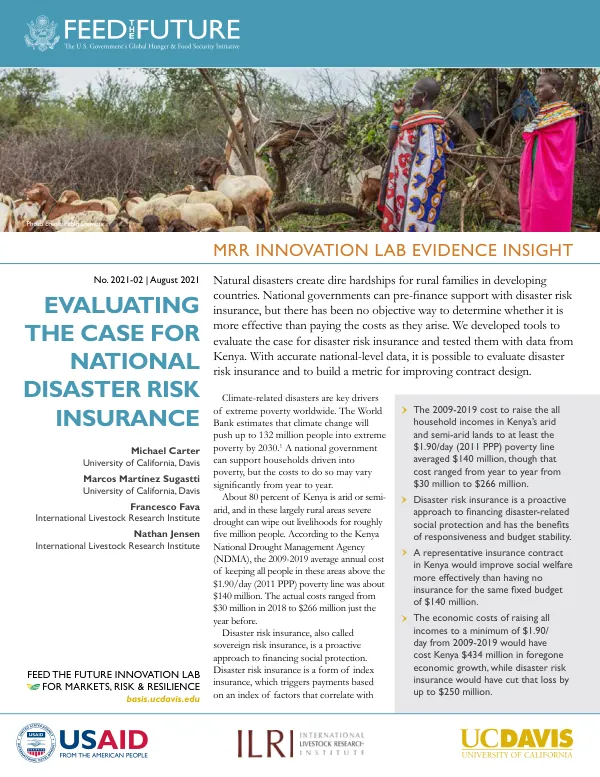
The economic costs of raising all incomes to a minimum of $1.90/day from 2009-2019 would have cost Kenya $434 million in foregone economic growth. Disaster risk insurance, on the other hand, would have cut that loss by up to $250 million. Kenya's arid and semi-arid lands are particularly vulnerable to severe drought, which can wipe out livelihoods for roughly five million people. The 2009-2019 average annual cost of keeping all people in these areas above the $1.90/day (2011 PPP) poverty line was about $140 million, with actual costs ranging from $30 million in 2018 to $266 million just the year before. Disaster risk insurance is a form of index insurance, which triggers payments based on an index of factors that correlate with losses, such as vegetation growth or rainfall, rather than actual losses. A representative insurance contract in Kenya would improve social welfare more effectively than having no insurance for the same fixed budget of $140 million. The social welfare metric is a risk-adjusted income-per-day for people vulnerable to a disaster. By this metric, when losses are more extreme, the value of support and the harm of not providing it are greater. Direct payments from only the fixed $140 million budget without insurance yields a social welfare metric of $1.67 per vulnerable person. Two types of insurance were tested against this pay-as-you-go fixed budget scenario: a hypothetical perfect insurance that perfectly matches actual costs, and a disaster risk insurance contract designed to be as similar as possible to contracts currently available. Both contracts trigger payouts when the costs to raise all incomes to at least $1.90/day exceed the fixed annual budget of $140 million. The annual insurance premium cost for both contracts roughly equals the average of payouts from 2009-2019 plus a 20-percent markup. Both types of insurance would raise the social welfare metric overall. Perfect insurance raises that metric to $1.80, while the disaster risk insurance contract raises the metric to $1.75. However, the contract would have overpaid in some years, increasing the cost of insurance premiums, and in other years would have underpaid, reducing needed funds. Research on public finance has found that budget volatility has an even bigger negative impact on long-term GDP than low levels of public investment. Disaster risk insurance would reduce the negative impacts of budget volatility. Paying the full 2009-2019 costs of raising incomes to $1.90/day would have reduced Kenya's GDP by $434 million. A perfect insurance contract with a 10-percent markup would have reduced GDP by only $179 million. The model index insurance contract, even with its failures, would have captured nearly all of those GDP-saving benefits. One key factor in whether disaster risk insurance is worthwhile is how accurately its index matches actual losses from year to year. If premiums cost $35 million and need is $266 million, as it was in Kenya in 2017, a perfect insurance contract would pay out $126 million. Added to the budget after premiums equals $231 million, which is less than what is needed but is also $91 million more than an annual budget of $140 million without insurance. However, if an actual disaster risk insurance contract failed to trigger payments at all, as nearly happened in Malawi in 2017, the government would have less than half of what was needed. The case study illustrates a framework to conduct an objective analysis of disaster risk insurance. With accurate national-level data on a disaster's impact, it's possible to test a disaster risk insurance contract to determine whether it provides the best means of supporting vulnerable citizens. It also provides a metric that can be used to improve the disaster risk insurance contract design.
Related documents