UNIVERSITY OF CALIFORNIA AT DAVIS
Resilience-Based Protection Blunts Climate Change's Impact on Poverty
Resilience-based protection programs are crucial for mitigating the impact of climate change on poverty.
2018 · 2 pages
Sign in to readA free account is required to download.
Abstract
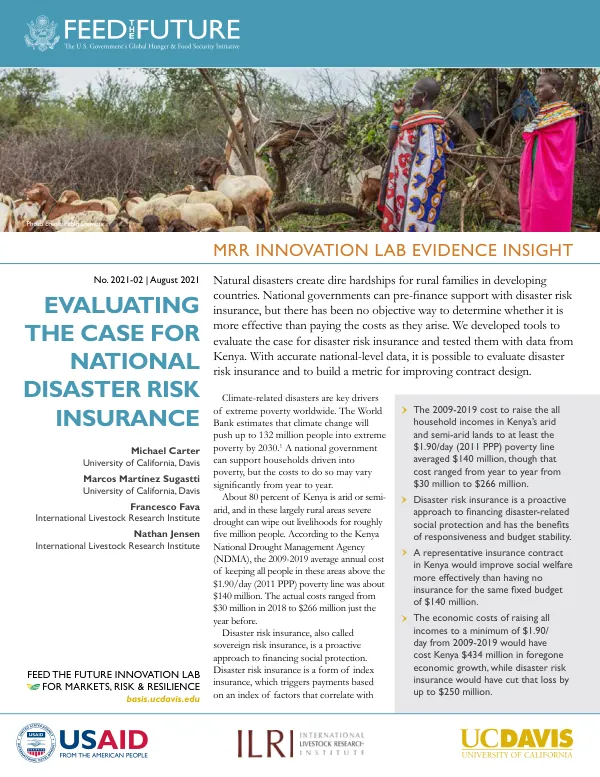
Catastrophic weather shocks, such as severe drought or flood, are a significant cause of poverty among rural households in developing economies. As the risk of these shocks increases, national social protection budgets will struggle to keep up with the number of households in need. Advanced economic modeling has been used to predict how well different social protection programs can address poverty in the face of climate change. The modeling suggests that a resilience-based approach to social protection, which includes insurance, is the only sustainable way to manage poverty in the long term. However, even this approach will fail if worst-case climate change scenarios come to pass. Rural households have a measure of productive assets and human capability that shape their wellbeing and economic viability over time. For pastoralist households, productive assets include the cows or goats a family owns, while for maize farmers, it includes the land or tools. Human capability, such as labor, knowledge, or social factors, helps determine what a household makes of those assets. When catastrophic weather shocks occur, poor and vulnerable households have few options for coping with less. Some sell their productive assets, such as livestock or equipment, to maintain their consumption, but at the expense of future productivity. Others cut meals and other types of consumption, which compromises adults' ability to work or the long-term physical and cognitive development of their children. Both coping strategies can create feedback loops that lead to poverty that lasts for generations. The modeling of social protection programs has shown that regular in-kind transfers that are targeted perfectly to the poorest households will eliminate all of their short-term shortfalls in consumption. However, with only this kind of transfer, the extent and depth of poverty increase over time as the next catastrophic shock adds newly poor households to the existing poor who have not yet accumulated the assets needed to get out of poverty. A contingent transfer program targeted to vulnerable households does a better job than in-kind transfers of slowing the overall growth in the total number of poor households. Across four generations in the simulation, the total number of poor declined by about one fourth. However, because these kinds of payments increase with the severity of the shock, in years with the highest losses, the smallest share of the social protection budget is dedicated to the poorest households. Insurance is one way to bridge these tradeoffs between support for poor households on the one hand and vulnerable households on the other. Insurance payments are more predictable than emergency aid, which is subject to government budgets and the ability to get funds to those in need. Also, if vulnerable households pay at least a share of the premium payments, insurance also has the potential to be self-sustaining, reducing the burden on public budgets and increasing the total funds available to support the poorest households. The resilience-based social protection approach is critical for addressing poverty, food security, and vulnerability in the face of climate-related shocks. One potential challenge is developing agricultural insurance that can be effectively and affordably scaled among rural households in developing economies. Index insurance has shown promise in this regard, as it bases payouts on losses estimated from an index of data from satellites, weather stations, or average losses in an area.