USAID DEC
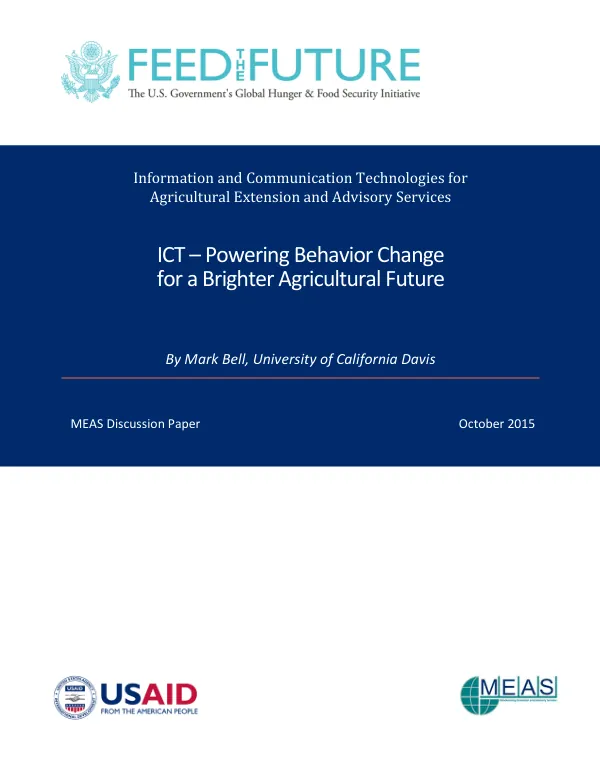
Information and Communication Technologies for Agricultural Extension and Advisory Services
Sign inCATHOLIC RELIEF SERVICES ORGANIZATION
Information and Communication Technologies for Agricultural Extension and Advisory Services
Agricultural extension and advisory services play a crucial role in addressing global poverty, particularly in rural areas where 75% of the world's 1 billion plus poor reside.
2015 · 44 pages
Sign in to readA free account is required to download.
Abstract
These individuals depend on agriculture to survive, and enhancing their livelihoods is essential to addressing poverty. Farmers face numerous challenges, including access to credit, better market prices, and credible, relevant information. Information and Communication Technology (ICT) has the potential to expand communication between people and improve access to information and money. However, harnessing the promise of ICT to help rural agricultural poor has been a challenge. Since the birth of the internet in 1994 and the spread of cell phones from the mid-1980s, many ICT for Agriculture (ICT4Ag) activities have been initiated, but many have seemingly oversold themselves in terms of success or ceased when project funding dried up. Despite these apparent false starts, a growing body of experience provides lessons on factors required for successful ICT applications in agricultural extension and how ICT can lead to beneficial behavior change amongst poor farmers. The expansion in internet access and the growth in mobile devices, particularly cell phones, drive optimism for ICT applications in extension. Partnerships between cell phone companies and the emergence of suites of services, such as financial services and market information, are also promising. The paper draws on lessons learned from health, business, advertising, and agriculture, as well as ICT for Development (ICT4D) reports, to identify principles for using ICT to facilitate behavior change. The "AID" model, which considers awareness, interest, and doability, is a key framework for successful initiatives. Additionally, three factors highlighted by successful organizations are acceptable upfront costs, flexibility and agility, and competent team members. The paper also examines various ICT options, including digital platforms, mobile applications, and social media, and their potential to facilitate behavior change in agricultural extension. Examples of successful initiatives, such as Digital Green, Farm Radio International, and the Rice Knowledge Bank, demonstrate the potential of ICT to improve access to information and promote behavior change. In conclusion, ICT has the potential to play a significant role in promoting behavior change in agricultural extension, particularly when used in conjunction with other factors such as awareness, interest, and doability. By understanding the principles and lessons learned from successful initiatives, organizations can harness the power of ICT to improve the livelihoods of rural agricultural poor and address global poverty. The "AID" model provides a framework for understanding the factors that contribute to successful behavior change initiatives. Awareness is critical, as individuals must be aware of the information and its benefits. Interest is also essential, as individuals must be motivated to learn more and engage with the information. Finally, doability is crucial, as individuals must be able to easily test and implement the information. In addition to the "AID" model, three additional factors were highlighted by successful organizations as essential for successful ICT initiatives. These include acceptable upfront costs, flexibility and agility, and competent team members. By considering these factors, organizations can increase the likelihood of success and promote behavior change in agricultural extension. The paper also highlights the importance of partnerships and collaborations in promoting behavior change in agricultural extension. Partnerships between cell phone companies, financial institutions, and agricultural organizations can help to expand access to information and improve the livelihoods of rural agricultural poor. In terms of implementation, the paper suggests that initiatives should focus on providing practical and simple information that is relevant to the needs and interests of the target audience. This can be achieved through the use of digital platforms, mobile applications, and social media, as well as other ICT options. Overall, the paper provides a comprehensive overview of the potential of ICT to promote behavior change in agricultural extension and highlights the importance of considering factors such as awareness, interest, doability, upfront costs, flexibility, and competent team members. By understanding these factors and leveraging the power of ICT, organizations can improve the livelihoods of rural agricultural poor and address global poverty.