USAID
Initiative mondiale sur les Changements climatiques au Mali
The agricultural development initiative in Mali is a response to the country's vulnerability to climate change.
2014 · 2 pages
Sign in to readA free account is required to download.
Abstract
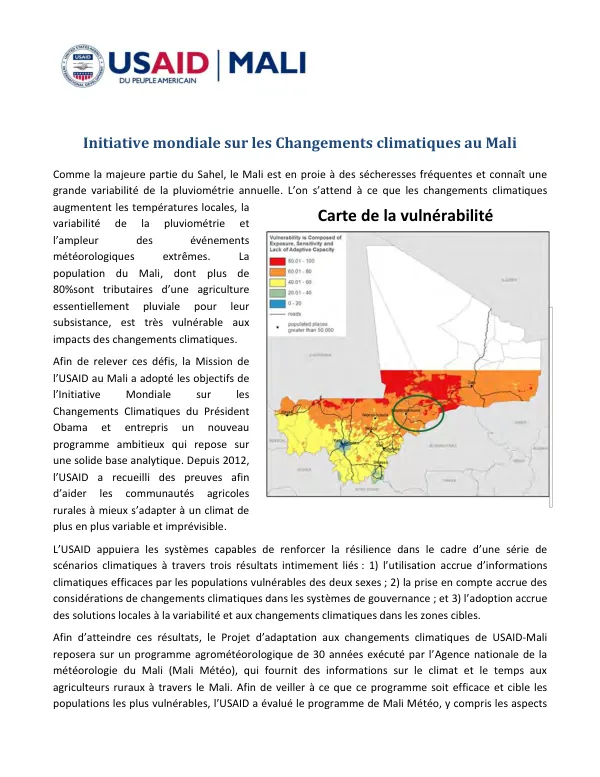
Mali, like much of the Sahel region, experiences frequent droughts and significant annual rainfall variability. Climate change is expected to exacerbate these conditions, increasing local temperatures, rainfall variability, and extreme weather event frequency. The Malian population, with over 80% reliant on rain-fed agriculture for subsistence, is highly susceptible to climate change impacts. To address these challenges, the USAID Mission in Mali adopted the objectives of the President Obama's Global Climate Change Initiative and launched a new ambitious program based on a solid analytical foundation. Since 2012, USAID has collected evidence to help rural agricultural communities adapt to a more variable and unpredictable climate. The USAID initiative will support systems that enhance resilience across a range of climate scenarios through three interconnected outcomes: 1) increased effective climate information use by vulnerable populations of both sexes; 2) increased consideration of climate change factors in governance systems; and 3) increased adoption of local climate variability and change solutions in target areas. To achieve these outcomes, the USAID-Mali Climate Change Adaptation Project relies on a 30-year agrometeorological program executed by the Malian National Meteorological Agency (Mali Météo), which provides climate and weather information to rural farmers across Mali. To ensure the program's effectiveness and targeting of the most vulnerable populations, USAID evaluated the Mali Météo program, including sociocultural aspects influencing climate information absorption within rural communities. The most vulnerable areas in Mali have been identified using a detailed vulnerability map. The analysis revealed that the regions in northern Mali, already marginal in terms of productivity, are among the most vulnerable. Building on ongoing efforts in the agricultural sector through the USAID Food Security for the Future Initiative, USAID will provide climate information to a "basket" of other agricultural interventions at the farmer and community levels, such as soil and water conservation and agroforestry. This holistic approach to agricultural livelihood production will enhance the resilience of vulnerable Malian communities.
Related documents